Air Freight to Singapore: Shipping Time-Critical Medical Devices & Diagnostic Equipment

For air freight to Singapore carrying time-critical medical devices, the delivery deadline is not simply the aircraft’s arrival time. Plan backward from hospital receipt, laboratory acceptance or an engineer’s installation appointment, with separate checkpoints for regulatory readiness, airline acceptance, customs release and product-condition review.
An urgent MRI replacement component and a temperature-sensitive diagnostic kit need different transport plans. Start with the exact product, its manufacturer-approved shipping conditions and the Singapore importer’s regulatory position, then select the flight and handling arrangements.
Image: National Institute of Mental Health, National Institutes of Health, public domain, via Wikimedia Commons. (commons.wikimedia.org)
Build a release plan for air freight to Singapore
Create one shipment file connecting the equipment to its purchase order, importer, receiving facility and transport instructions. Use the following as a planning checklist rather than treating a flight booking as permission to dispatch.
Planning checkpoint | Information to confirm | Suggested owner |
Product identification | Model, part number, quantity, serial or lot identifiers and intended use | Manufacturer or exporter |
Regulatory readiness | Applicable export requirements, Singapore licensing and device registration or exemption | Exporter and Singapore importer |
Product protection | Transport limits, approved packaging and monitoring instructions | Manufacturer’s quality team |
Airline acceptance | Packed dimensions, weight, screening arrangements and dangerous-goods assessment | Forwarder and airline |
Destination clearance | Declaring agent, permit information and consistent shipment documents | Importer and declaring agent |
Facility receipt | Receiving appointment, unloading arrangements and condition-review contact | Hospital, laboratory or service team |
Assign a named person to resolve each open item and an escalation contact available outside normal office hours. For a repair shipment, include the service reference and the identity of the component being replaced.
Keep the operational deadline specific: “delivered to the laboratory’s authorized receiver” is more useful than “arriving in Singapore.” Request separate estimates for flight arrival, cargo availability, customs release and final delivery.
Confirm Singapore medical-device import readiness
Singapore’s Health Sciences Authority (HSA) requires the applicable dealer’s licence for companies importing medical devices. Product registration is a separate question: Class A devices are exempt from registration, while other devices generally require registration unless an applicable exemption or authorized route applies. Verify the exact device and activity rather than relying on a broad description such as “hospital equipment.” (hsa.gov.sg)
For unregistered devices, HSA provides specific Special Access Routes, including routes for qualifying patient use, non-clinical purposes and certain repair-related movements. These are not automatic exemptions for urgent shipments. Establish the applicable route and obtain required approval before dispatch. (hsa.gov.sg)
Before releasing air freight to Singapore, ask the importer to confirm the regulatory status of the exact model and configuration. For an MRI component or accessory, resolve whether it falls within the relevant device authorization or needs a different treatment. Do not infer that every spare part has the same status as the complete system.
Have the importer and declaring agent agree on the supporting information before collection. A hospital delivery address alone does not establish who holds the required licence or who will submit the import declaration.
Apply GDP controls appropriate to medical devices
For Singapore medical logistics, distinguish pharmaceutical Good Distribution Practice from the Singapore Standard for Good Distribution Practice for Medical Devices (GDPMDS). HSA’s medical-device framework recognizes different quality-management evidence depending on the dealer’s activities and device categories, including qualifying ISO 13485, MDSAP or GDPMDS certification. A declaration route applies in specified circumstances, such as dealing only with Class A devices. (hsa.gov.sg)
HSA’s GDPMDS guidance addresses secure delivery, manufacturer-specified storage conditions, traceability and control of outsourced activities. It also calls for measuring instruments to be calibrated or verified regularly. These are operational controls, not simply labels to add to an air waybill. (isomer-user-content.by.gov.sg)
Ask prospective providers how their documented procedures cover your shipment. Request evidence relevant to the actual service scope, including subcontracted storage or delivery, rather than accepting a general claim of “GDP compliance.”
Put responsibilities in writing. Identify who can authorize a routing change, who receives an excursion alert and who decides whether affected goods remain suitable for use. Keep the manufacturer’s quality representative separate from the person arranging the flight when their decisions require different expertise.
Match packaging to the equipment and its transport limits
For air freight to Singapore, request a written packaging and handling specification from the manufacturer before asking a warehouse to build a crate. Use it to establish restraint, cushioning, orientation, lifting points and any environmental limits.
Diagnostic machinery and replacement components
Ask the manufacturer whether transport locks, electrostatic-discharge protection, moisture barriers or special lifting arrangements are needed. For heavier equipment, provide the packer and forwarder with the center of gravity and approved forklift or lifting positions.
Specify how package condition will be recorded at collection and delivery. Photographs, serial-number reconciliation and seal records can form part of the agreed handover procedure. Use shock or tilt indicators only with defined inspection and escalation instructions.
Treat these measures as a product-specific engineering review, not a universal packing recipe. A crate designed for one analyzer should not be reused for another model without approval.
Surgical instruments and diagnostic kits
For sterile instruments, instruct handlers not to open the sterile barrier as part of routine repacking. Agree in advance how any inspection will be managed and who will assess packaging damage before clinical release.
For diagnostic kits, obtain the permitted transport range and excursion criteria. Do not assume every kit requires refrigeration or select a temperature range merely because it is common in healthcare shipping. HSA’s guidance bases appropriate storage conditions on the manufacturer’s recommendations. (isomer-user-content.by.gov.sg)
Monitor temperature across the complete journey
When temperature control is required, define the monitoring plan before pack-out. Specify logger identification, placement, recording interval and the person responsible for reviewing the data. Also establish the action to take if the logger fails or the shipment arrives outside its approved limits.
Build the contingency plan around the entire journey, including collection, terminal handling, connections, clearance and delivery. Ask how the shipment will be protected if it misses the booked flight and where it can be held under suitable conditions.
IATA publishes guidance covering battery-powered cargo tracking devices and data loggers, including conditions for their carriage in aircraft cargo compartments. Confirm acceptance of the selected device with the carrier rather than assuming any logger can remain active in flight. (iata.org)
For temperature-controlled air freight to Singapore, require an explicit handover between the transport team and the receiving quality team. Delivery confirmation should trigger retrieval and review of the monitoring record, not close the shipment automatically.
Check dangerous goods before airline tender
Medical cargo is not automatically dangerous goods, but healthcare shipments can contain regulated items. Lithium batteries, dry ice and infectious substances require assessment under the applicable air-transport rules. IATA provides dedicated guidance and acceptance documentation for these categories. (iata.org)
Give the forwarder an itemized contents list, including accessories, batteries, refrigerants and any specimens shipped alongside equipment. Keep diagnostic instruments distinct from patient samples when describing the shipment.
For MRI-related cargo, disclose any magnets, cryogens or pressurized components to the manufacturer and the dangerous-goods specialist for assessment. Do not classify a shipment solely from the term “MRI component.”
Resolve the assessment before final packaging. Ask the airline to confirm any restrictions affecting the proposed route, aircraft or packing arrangement so an acceptance issue does not emerge at the cargo terminal.
Understand what FDA export clearance actually means
For U.S. departures, “FDA export clearance” should not be treated as a universal shipment approval. FDA states that medical devices legally marketed in the United States may generally be exported without prior FDA notification or approval to export. Devices that cannot be legally marketed in the United States must follow the applicable export provisions of the Federal Food, Drug, and Cosmetic Act. (fda.gov)
An FDA export certificate documents specified regulatory or marketing-status information. It is not the same as Singapore import authorization. Determine whether the overseas customer or authority requires a certificate and which document matches the device’s status. (fda.gov)
Before booking air freight to Singapore, separate the FDA review from other applicable U.S. export and filing obligations. Ask the exporter’s compliance team to provide its release decision and supporting instructions rather than expecting the forwarder to infer eligibility from a commercial invoice.
Prepare customs clearance before departure
Singapore Customs requires the relevant customs permit before importation, subject to applicable exceptions. For health products subject to HSA licensing or approval, declarations must include the applicable HSA product codes and relevant licence or approval information. (customs.gov.sg)
Send the declaring agent a complete pre-alert package early enough to correct discrepancies before uplift. Include the commercial invoice, packing list, air waybill details and the regulatory information the agent requests. Singapore Customs identifies these shipping documents among the supporting records used for clearance. (customs.gov.sg)
Use meaningful descriptions such as the device type, manufacturer, model and intended purpose. Reconcile quantities, package counts, values and identifiers across the documents. For loaned or warranty equipment, ask the agent how to declare the transaction and value rather than using “no commercial value” as a shortcut.
Pre-clearance preparation does not guarantee release without inspection. Agree on an examination contact, suitable holding arrangements and a process for restoring approved packaging if inspection requires opening a package.
Select the route against the clinical deadline
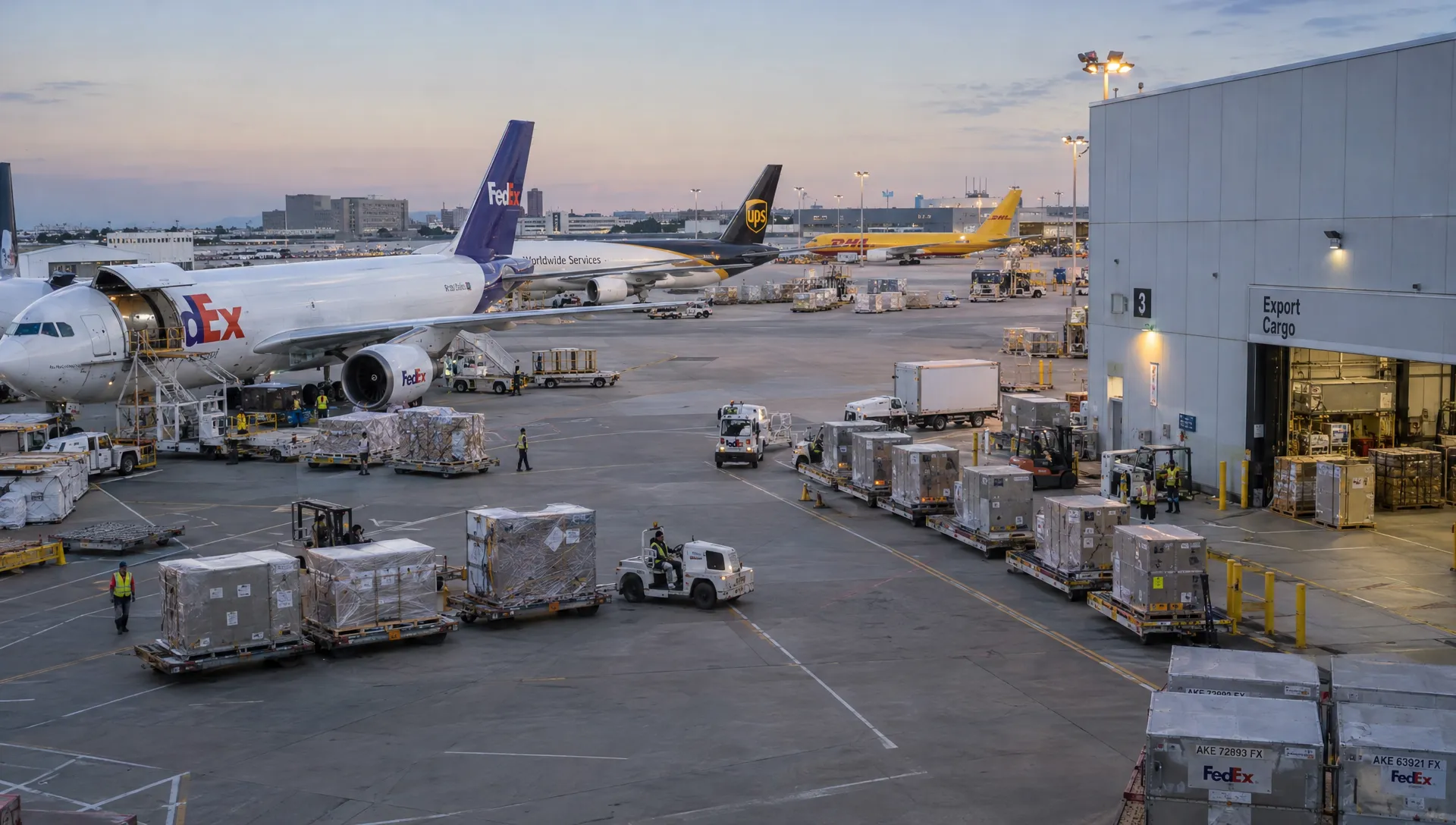
Compare transport proposals against the required facility-receipt time, not just flight duration. Ask each provider to identify planned connections, handling locations, acceptance cutoffs and contingency options.
For air freight to Singapore, request confirmation of the complete service scope: collection, packing coordination, screening, uplift, destination handling, clearance arrangements and final-mile delivery. Clarify which charges are included and how storage, inspection or rebooking costs will be handled.
Before departure, confirm the receiving appointment, loading-bay access, unloading equipment and engineer availability. For sensitive machinery, ask the manufacturer whether acclimatization or post-transport checks are required before unpacking, energizing or installation.
Keep contingency decisions practical. If a connection is missed, the next action should already be assigned, including who approves a revised route and who checks whether the packaging and environmental-control plan remain suitable.
Frequently asked questions
How long does shipping medical devices to Singapore take? Obtain a shipment-specific schedule covering origin pickup through facility receipt. A flight estimate alone does not include packing, airline acceptance, clearance or the receiving appointment. Ask the forwarder to identify the assumptions behind its proposed delivery time.
Do all medical devices need refrigerated transport? No single temperature range applies to all devices. Follow the manufacturer’s specified conditions and agree on appropriate packaging and monitoring for the exact product. (isomer-user-content.by.gov.sg)
Does FDA clearance allow a device to enter Singapore? Not by itself. FDA status and Singapore’s licensing, registration and import requirements are separate regulatory questions. Confirm both before dispatch. (fda.gov)
Can an unregistered device be imported for urgent patient use? HSA has Special Access Routes for qualifying situations, but urgency alone does not establish eligibility. The responsible Singapore party must confirm the applicable route and obtain required approval. (hsa.gov.sg)
Plan your time-critical medical shipment
Preparing air freight to Singapore for diagnostic equipment or an urgent replacement component? Contact SHIPIT Logistics to discuss routing and execution requirements. SHIPIT offers international air-freight services; confirm the product-specific handling scope and any specialist arrangements needed for your shipment. (shipit.com)
Bring the model and part numbers, packed dimensions, manufacturer’s transport instructions, Singapore importer details and required receiving time. Request a plan that identifies responsibilities from collection through documented facility handover.