Vetting Supply Chain Solution Providers for Buyer Consolidation

Buyer consolidation only pays when the savings survive supplier delays, handling charges and inventory consequences. For procurement teams vetting supply chain solution providers, the central question is not who can combine freight. It is who can make defensible release decisions across multiple purchase orders without compromising plant continuity, customs compliance or delivery commitments.
A useful evaluation follows the shipment from supplier readiness through final receipt, including the orders that should bypass consolidation entirely. Require evidence of how each bidder balances routine replenishment with urgent components, controls custody at every transfer and assigns authority when cost and schedule conflict.
Start with the consolidation release rule
Define the program at purchase-order level: supplier location, cargo-ready date, required delivery date, dimensions, gross weight, handling restrictions and the party controlling freight under the purchase contract. Separate ready-to-ship inventory from forecast quantities. A consolidation plan built on unconfirmed production dates creates false capacity commitments.
Ask bidders to model three decisions for every order: wait for another supplier, release the available cargo or upgrade only the constrained portion. The comparison should use a common required-on-site date and include receiving capacity, not just vessel or aircraft departure.
Strong supply chain solution providers calculate the latest safe release point backward from delivery, incorporating origin receiving, documentation, transport, clearance and destination appointments. They also specify who can authorize a split shipment when a missing valve or controller threatens commissioning.
Pro-Tip: Set a maximum consolidation dwell and an exception trigger by SKU criticality. A low-value part can justify expedited freight when its absence prevents installation of a much larger asset.
At contract stage, align supplier instructions and purchase terms with that authority. If suppliers select their own pickups or route cargo independently, the provider may lack the control needed to enforce the agreed release calendar. Make authority to consolidate explicit, including when purchase-order terms or supplier commitments must change before the program begins.
Demand evidence from supply chain solution providers
Separate execution capability from software capability before scoring. A visibility platform can surface a missed milestone without controlling the truck, warehouse or booking that fixes it. Identify the contracting entity, operating locations, subcontracted activities and named escalation owner for each proposed flow.
Use an illustrative weighted scorecard, with mandatory gates outside the numerical total:
Evaluation area | Required evidence | Example weight |
Release governance | Tested hold/release rules and authorized approvers | 25% |
Execution coverage | Verified facilities, carriers and gateway contingency plans | 25% |
Cost transparency | Comparable accessorials and landed-cost assumptions | 20% |
Compliance and custody | Document ownership, cargo controls and exception procedures | 20% |
Integration readiness | Sample events, identifiers and reconciliation results | 10% |
Treat applicable operating authority, cargo acceptance and required handling capability as pass/fail gates. A high total cannot offset a facility that cannot accept the commodity or a party that cannot perform its contracted role.
Request anonymized shipment files showing planned versus actual dates, exception messages and final invoices. Then speak with references running comparable supplier density, cargo characteristics and destination constraints. Ask what happened during the most recent missed consolidation cutoff, not whether the relationship is generally satisfactory. Require evidence from the proposed operating team, not a case study managed by a different office.
Pressure-test ocean consolidation and container plans
Test whether supply chain solution providers can build a load plan that protects both utilization and release speed. For standard ocean freight, compare supplier-level LCL through a container freight station (CFS) with buyer-specific FCL consolidation; neither should win automatically on rate per cubic meter.
Require a realistic equipment plan for 20-foot and 40-foot dry containers, 45-foot equipment where available and reefers when temperature control is necessary. Verify payload, commodity compatibility, packaging strength and destination handling limits. Reefer acceptance must follow product requirements rather than a generic assumption that all temperature-sensitive cargo can share space.
For LCL, inspect origin receiving cutoffs, consolidation frequency, destination deconsolidation milestones and the charging basis for storage. For FCL, request a supplier receiving schedule, stuffing sequence, seal record and purchase-order-to-container manifest. A high cube utilization figure is not sufficient if unloading blocks access to priority material.
Stress-test a missed supplier cutoff and a rolled sailing. The bidder should show whether cargo waits, moves through another service or separates into an urgent shipment, together with the cost authority for each option. Require visibility into free-time assumptions so a cheap origin consolidation does not become an expensive destination exception. Include a contingency when supplier cargo arrives after receiving closes but before vessel cutoff.
Give air imports and exports equal scrutiny
Air should be an engineered exception or a planned high-value flow, not an undefined rescue promise. Ask supply chain solution providers to demonstrate both directions using the same delivery deadline and approval threshold.
US-origin air exports
For US-origin exports, verify factory or warehouse pickup, TSA-compliant acceptance and security screening through the applicable Indirect Air Carrier process, EEI filing through AES when required and export-control checks. Request cutoff evidence for consolidation, charter and next-flight options, plus responsibility for foreign customs coordination and final delivery. Confirm that the chosen service accepts the shipment's dimensions, commodity and security status.
US-destination air imports
For US-destination imports, verify foreign pickup and airport acceptance, international uplift, US customs clearance coordination, airport cargo-terminal transfer and final-mile delivery. Test NFO or AOG escalation against actual cargo availability and release requirements, not flight arrival alone. For temperature-sensitive components or reagents, require monitoring, excursion instructions and clear responsibility during airport dwell and handoffs. Confirm consignee receiving hours before booking.
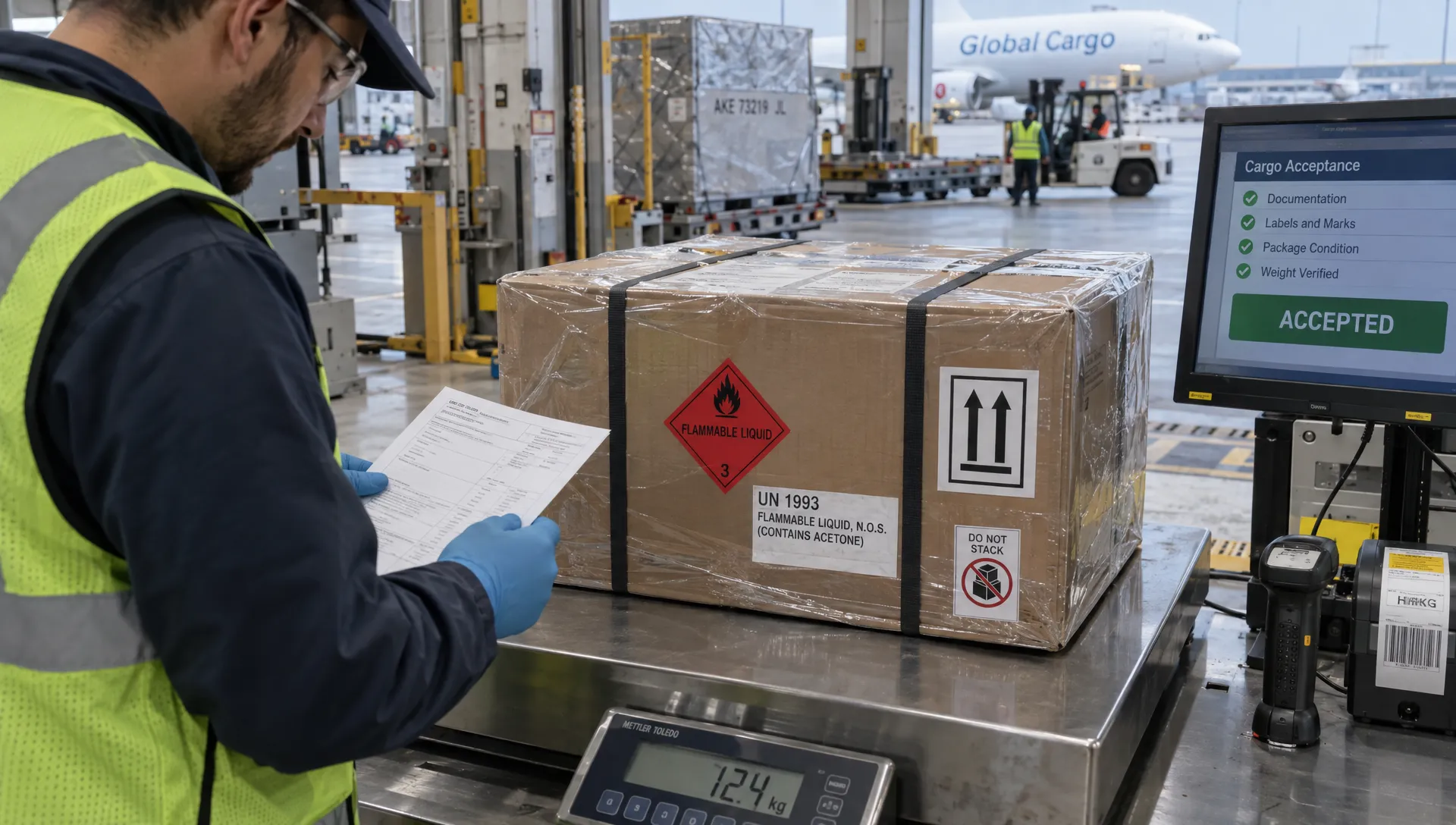
Across both directions, demand current IATA/ICAO dangerous-goods acceptance checks where applicable. Compare the premium for moving only shortage-critical quantities by air against the inventory exposure of waiting for ocean replenishment. Lithium battery restrictions, packaging and carrier approval can eliminate an assumed air fallback. Require a named recovery owner for missed uplift and a documented security handoff for high-value electronics in either direction. Confirm document correction procedures before either shipment reaches acceptance. Require separate export and import escalation contacts, with coverage aligned to origin handover times, destination release hours and the buyer's operating calendar.
Make port drayage executable before the vessel arrives
Make supply chain solution providers demonstrate the port-to-facility move as a timed sequence, not an included line item. Match container availability, customs and other holds, terminal appointments, chassis supply, driver dispatch and warehouse receiving windows. Identify separate owners for terminal release and physical dispatch.
Request the drayage partner's actual operating coverage for the selected terminal and inland delivery point, including overweight or reefer requirements. A carrier's regional footprint does not establish access to every terminal or capability for every equipment type. Assess network claims against executable coverage, especially when a secondary gateway changes the inland leg.
Evaluate proposed gate optimization through specific controls: appointment monitoring, last-free-day alerts, pre-pull criteria, approved storage locations and empty-return instructions. Ask who pays when a missed warehouse appointment causes an extra chassis day, and distinguish terminal demurrage from equipment detention in the rate schedule. Set alert deadlines early enough for dispatch changes, rather than reporting last-free-day exposure after terminal options have closed.
Require a recovery plan for unavailable return appointments and changing empty-return locations. For an overweight container of battery materials, verify legal road weights, permits where needed and equipment before vessel arrival. Include the reefer power plan during any approved off-terminal dwell; do not assume a standard container yard can provide it.
Audit the consolidation floor and inventory records
Facility capability determines whether purchase orders remain traceable after freight is combined. Ask supply chain solution providers for a walkthrough showing receiving checks, discrepancy holds, storage segregation, pallet rebuilding and outbound verification. Physical labels should reconcile to supplier, PO, SKU, lot or serial number as the cargo requires.
Distinguish cross-docking from buffer storage in the operating plan and quote. Cross-docking requires synchronized inbound and outbound capacity; inventory buffering needs defined locations, cycle-count rules and aging controls. Neither should be added to a direct air move simply because warehouse space is available.
For a proposed three-container-to-two-container transload, require a validated cube-and-weight calculation, loading sequence and cargo-protection method. The ratio is an operating hypothesis, not a guaranteed saving. Solar modules, machinery crates and dense components can reach weight, stacking or damage limits before theoretical cubic capacity is filled.
Test the facility with a receipt shortage, an unannounced supplier delivery and mixed-lot inventory. Confirm who stops loading, how discrepancies are photographed and when the buyer receives an actionable count. Price unloading, sorting, relabeling, storage, after-hours work and rehandling separately, then identify which tasks disappear when goods move directly to their destination.
Keep project cargo inside a separate engineering scope
Do not let a strong container program qualify a bidder automatically for heavy lift. Project cargo requires its own engineering review, commercial scope and release authority, even when the same buyer wants one coordinating provider.
For EPC and industrial buyers, ask how supply chain solution providers separate oversize skids, transformers or manufacturing machinery from routine consumables. Require verified dimensions and weight, center-of-gravity information, lifting points, packaging drawings and route constraints before accepting equipment or price commitments.
A credible plan evaluates breakbulk, OOG flat racks and suitable heavy-haul configurations against actual handling constraints. It identifies route surveys, bridge reviews, permits, escorts, crane interfaces and job-site ground conditions as applicable. Do not accept an ocean booking as proof that the destination road movement is feasible.
Request a delivery-sequence plan tied to foundation readiness, crane availability and laydown space. Buffer storage is justified when it protects the installation schedule, but every added lift introduces handling exposure. Set inspection, custody and insurance responsibilities at those lifts.
Use a scenario involving a delayed control cabinet alongside an on-time transformer. The bidder should explain whether the cabinet can move independently by air while the heavy unit retains its engineered route, rather than delaying both under one consolidated milestone.
Compare total landed cost under one baseline
Normalize each quote to identical supplier origins, shipment profiles, ready dates, delivery commitments, free-time assumptions and Incoterms. Separate charges controlled by the bidder from pass-through items and buyer-controlled delays. Ask for the rate validity, currency assumptions, fuel mechanism and approval rules for unquoted accessorials.
Use a transparent calculation: supplier pickup plus origin receiving and handling plus main carriage plus destination charges plus drayage plus any storage, insurance and final delivery. Add inventory carrying cost and expected disruption exposure as separate decision inputs; do not bury speculative outage losses inside a freight rate.
Require supply chain solution providers to compare consolidation against direct shipment using the same landed-cost boundary. Show customs duties and taxes where relevant, but do not assume combining suppliers changes classification, origin or eligibility for preferential treatment. Require the customs broker to validate valuation and filing treatment.
Ask for a worked example with a late supplier, an inspection and a failed delivery appointment. The final invoice should show who bears storage, rehandling, chassis and expedited recovery costs. Compare this structure with your broader freight procurement process rather than awarding on a headline transportation discount.
Require a savings report that deducts implementation and operating charges from any claimed consolidation benefit. A lower ocean rate is not a program saving if added dwell forces recurring air expedites or increases obsolete inventory. Review savings by PO cohort, not only aggregate monthly spend. Confirm whether minimums apply per supplier, receipt, document or shipment, since fragmented orders can change the effective economics.
Establish compliance and cargo acceptance before tender
Identify the parties responsible for classifications, export controls, sanctions screening, dangerous-goods declarations and customs submissions. Verify applicable authority and licenses for each contracted role and jurisdiction, including ocean intermediary and motor-carrier or broker roles where relevant. Confirm which customs brokers are appointed and how filing instructions reach them.
Ask supply chain solution providers to produce a responsibility matrix for supplier documents, commercial invoices, packing lists, security filings and exception escalation. The buyer and importer or exporter retain legal responsibilities that cannot be erased by an end-to-end service description.
For mixed-supplier programs, test whether one incomplete invoice or restricted commodity can hold unrelated cargo. Require a lawful segregation or split-shipment procedure rather than a promise to work around controls. For batteries, chemicals, controlled aerospace items or biological materials, acceptance must be commodity-specific and mode-specific.
Review liability limits, subcontractor terms and cargo insurance separately. Establish declared values, exclusions, deductible responsibility and notice procedures before goods enter custody. Confirm how surveyors, evidence preservation and claims are coordinated after concealed damage or a temperature excursion. Insurance does not replace packaging verification or documented handling instructions. For reefer or monitored freight, specify acceptable temperature ranges and excursion escalation; a device reading alone does not establish product disposition.
Test data ownership, not dashboard demonstrations
Give bidders a small, representative dataset and require an event-level reconciliation. Each PO line should remain linked to supplier booking, warehouse receipt, pallet or crate, transport document, container or air waybill and final proof of delivery. Test splits and merges, not just complete shipments.
Qualified supply chain solution providers should explain who owns each event, how it is transmitted and what happens when it arrives late or conflicts with another status. API or EDI connectivity is useful only when identifiers, timestamps, status definitions and exception ownership agree.
Evaluate data latency at the decisions that matter: a supplier misses readiness, a container becomes available, cargo clears customs or a delivery appointment changes. Distinguish scheduled events from confirmed events. A flight arrival message should not imply that freight is released for collection.
Request an implementation plan naming buyer, supplier and provider resources. Include master-data cleanup, supplier onboarding, interface testing, access permissions and ongoing support charges. Retain a workable manual fallback for outages and define reconciliation after service returns.
Finally, verify data export rights and retention periods. The buyer should be able to retrieve PO history, inventory balances, documents and exception records when changing providers, without reconstructing the program from emailed spreadsheets.
Run a controlled pilot with measurable acceptance
Pilot the actual supplier pattern rather than a conveniently simple shipment. Include at least one routine consolidation and selected exceptions appropriate to your cargo: a late ready date, a quantity discrepancy, a split release or a constrained destination appointment. Use controlled simulations when a live test would introduce unacceptable risk.
Require supply chain solution providers to agree on acceptance criteria before execution. Measure PO completeness at release, consolidation dwell, inventory accuracy, document accuracy, delivery against the required date and total landed-cost variance. Define numerators, denominators and exclusions so performance cannot improve merely by removing difficult orders from the report.
Track an example metric such as on-time release as shipments released by the agreed cutoff divided by shipments due for release. Pair it with delivery performance and exception cost; otherwise a bidder can hit departure targets while leaving shortage-critical material behind. Set thresholds from your operating requirements, not an unsupported industry benchmark.
Pro-Tip: Replay the pilot's worst exception in a joint review. Ask the operator, warehouse lead and account owner to reconstruct decisions from timestamps and approvals, then compare their account with the invoice and inventory record.
Close the pilot with named corrective actions, owners and due dates. A successful shipment without a reproducible control process is weak evidence. Expand volume only after the remaining operational gaps have been accepted or closed by the buyer.
Contract the release authority and recovery obligations
Translate the selected design into an operating agreement, not just a rate sheet. Define daily cutoff calendars, supplier booking rules, maximum dwell, cargo acceptance, discrepancy tolerances and the authorized contacts for cost or schedule changes. Include weekend coverage where the actual lane requires it.
Hold supply chain solution providers accountable for decision response times as well as shipment milestones. Specify escalation paths, emergency spend limits, subcontractor disclosure and approval requirements for gateway, facility or mode changes. Assign responsibility for correcting inventory records after a diversion, partial delivery or damage event.
Preserve modularity in the contract. You may need an origin consolidation program with a separate destination carrier, drayage-only support, transload-only capacity or standalone US air import or export execution. Scope boundaries should describe custody, data and decision handoffs so modular purchasing does not create unowned exceptions.
Agree on a regular review of supplier readiness patterns, accessorial causes and bypass frequency. If urgent air shipments become routine, revisit order timing and release rules instead of treating expedites as an unavoidable operating cost.
Finally, document the exit process: release of stored inventory, open bookings, outstanding claims, data transfer and supplier notification. A provider change should not strand freight or erase the evidence needed to reconcile the last billing cycle.
Frequently asked questions
When should buyer consolidation be bypassed? Bypass it when waiting breaches the required delivery date, compatibility rules prevent shared loading or added handling creates unacceptable product risk. Apply the documented release rule rather than making an informal exception. Require approval from the buyer's designated decision-maker before changing a booked routing or releasing only part of an order.
How should supply chain solution providers prove savings? Compare identical shipment cohorts and delivery requirements, including receiving, handling, transport, storage, accessorials and implementation costs. Report inventory effects and expedited recovery separately so lower linehaul rates do not conceal higher operating costs.
Can one program combine routine freight and project cargo? Yes, through coordinated planning, but engineered heavy-haul and lifting requirements need separate acceptance and execution controls. A shared commercial relationship does not justify combining incompatible cargo or treating a project move as standard consolidation. Price exceptional handling separately so routine volume does not subsidize unmeasured project risk.
Discuss your buyer consolidation lanes with Shipit Logistics. Its ocean, two-way air, port drayage, cross-dock, warehousing and project cargo capabilities can support an integrated program or a defined standalone scope. Bring supplier readiness data, required delivery dates and handling constraints to establish the right operating boundaries.