3PL Fulfillment Services for Serial-Lot Traceability

A warehouse can reconcile every pallet and still lose the connection between a shipped serial number and its manufacturing lot. For industrial supply chains, selecting 3pl fulfillment services requires testing that connection through receiving, allocation, freight handoffs, delivery and returns. Aggregate inventory accuracy does not establish whether a specific component was eligible to ship or where other units from its lot went.
The operating requirement is more precise: preserve identity, control release and reconstruct movement without relying on someone to reconcile spreadsheets after an exception. That matters for semiconductor components, battery subassemblies, power equipment and other cargo where a targeted hold must not stop unrelated inventory.
Define identity before configuring transactions
Establish the inventory identity with the manufacturer and beneficial cargo owner before mapping warehouse transactions. A serial number identifies an individual unit within an agreed namespace. A lot identifies a manufacturing group. Neither should be assumed globally unique across suppliers or product families.
The required record depends on the product, but the following distinctions should be explicit:
Record | Required distinction |
Item identity | Manufacturer, part number and applicable revision |
Lot identity | Manufacturing lot and supplier namespace |
Unit identity | Serial number linked to the correct item and lot |
Handling unit | Carton, pallet or crate identifier with its contents |
Inventory status | Available, reserved, quarantined or otherwise restricted |
Movement event | Time, location, transaction reference and responsible party |
A pallet identifier must not replace its contents’ identities. If a pallet is split, the system must retain the original relationship and establish new handling-unit associations.
Where GS1 identification is used, an SSCC identifies a logistics unit, not the manufacturing lot itself. The GS1 EPCIS standard provides a framework for exchanging visibility events. Standards help structure the data, but trading partners still need agreed identifiers and event rules.
Where should 3pl fulfillment services enforce release gates?
Receiving: separate physical arrival from available inventory
Receiving should validate expected identifiers against an advance shipping notice, purchase order or approved manufacturer record. Define whether capture occurs at every unit, through a validated aggregation or by another approved method. A pallet scan alone is insufficient when its contents have not been reliably associated with that pallet.
Unreadable labels, duplicate serials, unexpected lots and quantity discrepancies need separate exception codes. Put affected inventory into a controlled status while preserving the original scan and discrepancy record. Do not make it available simply because a receiving transaction must be closed.
Allocation: apply restrictions before a pick is released
Allocation rules should evaluate lot restrictions, revision compatibility, customer approvals and shelf-life requirements where applicable. FEFO is appropriate for expiring inventory, but it does not override a quality hold or an engineering restriction.
Validate eligibility again during picking and shipment confirmation. A hold introduced after allocation must stop the affected unit before dispatch. Customs release, quality release and commercial authorization are separate conditions, not interchangeable status labels.
Pro-Tip: Test a hold applied after picking but before loading. This exposes workflows that check eligibility only when the order is first allocated.
Preserve identity across five freight handoffs
For multimodal programs, 3pl fulfillment services need a traceability boundary at each transfer of custody, not just at the warehouse door. Require consistent shipment references while retaining the distinction between cargo identity and transport equipment identity.
Ocean freight: connect FCL and LCL records to actual contents
For FCL, map the container and seal to its handling units and their serial-lot contents. Support 20-, 40- and 45-foot dry containers, or suitable reefer equipment, according to cargo and lane requirements.
For LCL and buyer’s consolidations, preserve house-shipment and CFS references through consolidation and deconsolidation. When multiple suppliers contribute cargo, retain their separate lot namespaces. A container-level milestone does not prove that every expected component arrived or remained within required environmental limits.
Air freight: preserve the same controls in both directions
For US exports, connect factory or warehouse pickup to packing records, TSA-compliant IAC security and screening arrangements, EEI/AES filing when required and export-compliance release. Carry the identity mapping through consolidation or charter uplift to foreign delivery.
For US imports, connect foreign pickup, international uplift, customs clearance coordination and airport ramp transfer to final-mile delivery. NFO/AOG urgency must not bypass serial verification. Retain cold-chain records where required and apply applicable IATA/ICAO dangerous-goods requirements in both directions.
When shifting modes, 3pl fulfillment services should preserve the original inventory identity rather than create an unlinked replacement record for the expedited shipment.
Port drayage: separate gate execution from inventory release
Link the container, seal, chassis movement and delivery appointment to the relevant shipment. Validate terminal availability, customs status, carrier release and equipment constraints before dispatching the truck.
Gate optimization and free-time monitoring help mitigate demurrage and detention, but those milestones do not establish lot-level availability. Record seal discrepancies and unexpected delivery locations as custody exceptions. Keep restricted inventory blocked even when the container has successfully outgated.
Cross-dock transloading and warehousing: rebuild packaging relationships
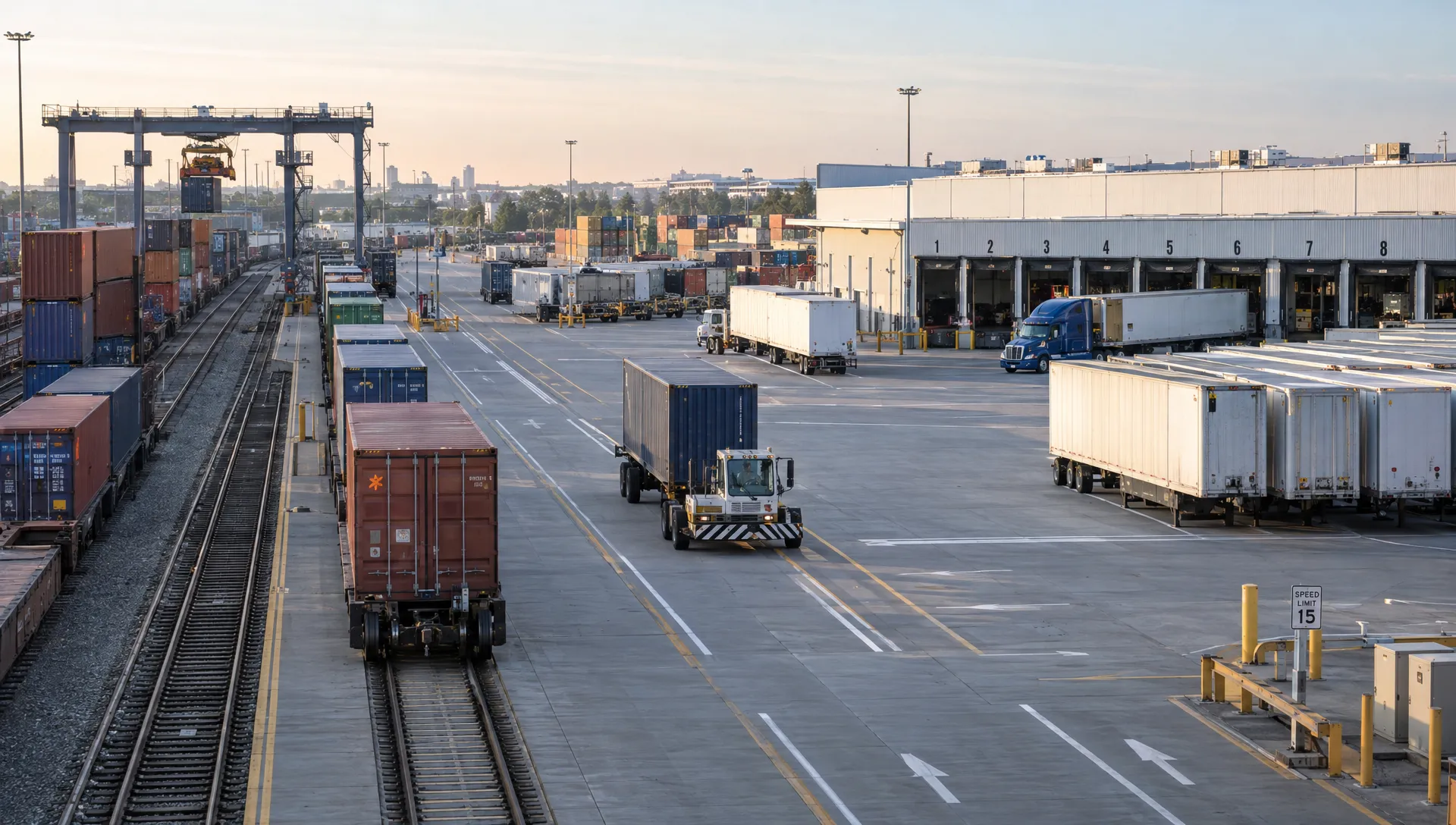
Use transloading when congestion, equipment utilization or delivery requirements justify it. During a container-to-trailer transfer, retain each unit’s identity while recording new pallet, trailer and location associations.
For a proposed three-container-to-two-trailer consolidation, validate weight, cube, compatibility and handling limits before execution. Buffer storage adds a location and status-control requirement. It should not erase the inbound lot relationship or turn mixed inventory into an undifferentiated bulk balance.
Project cargo and heavy haul: protect identity through preparation
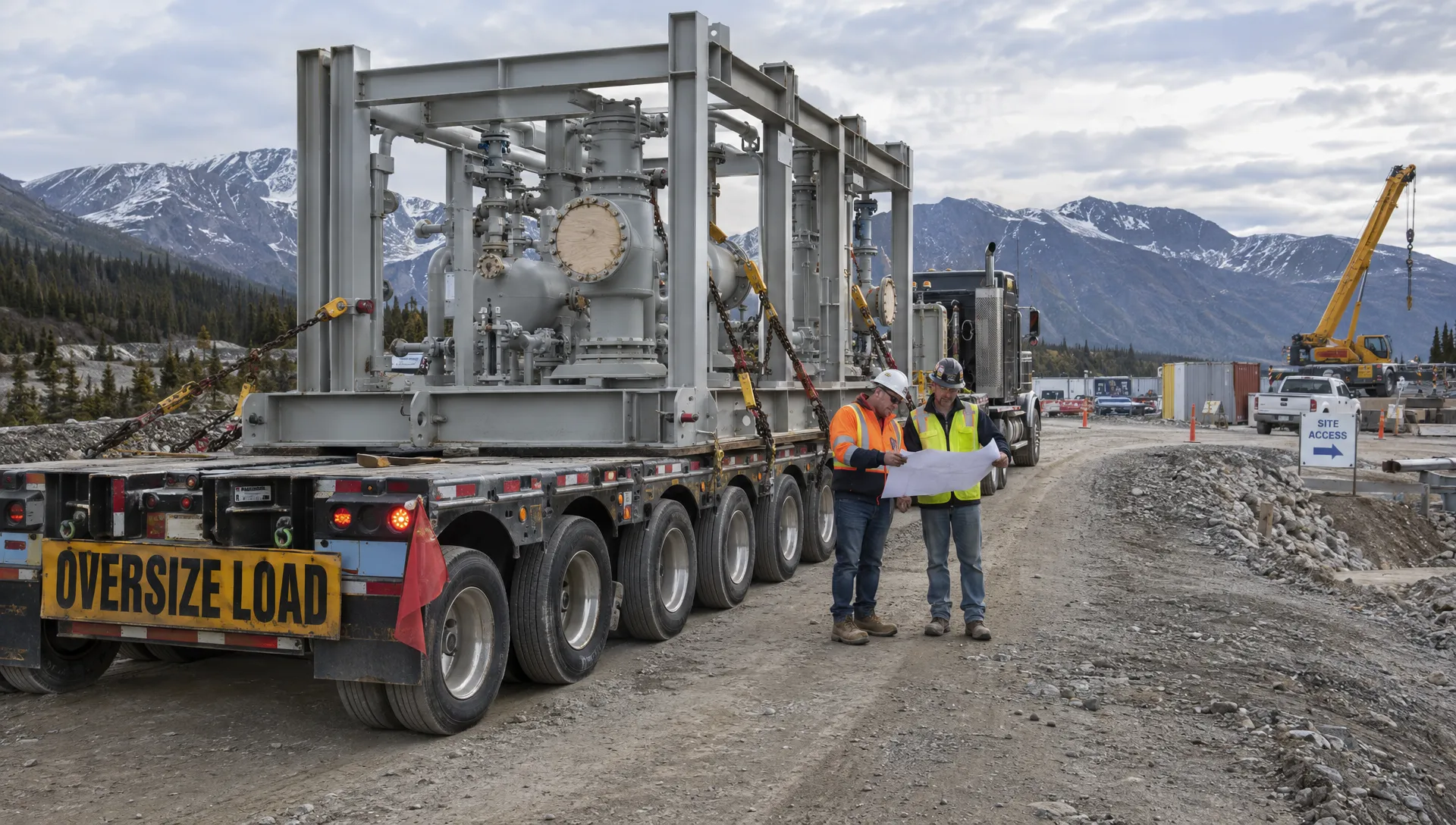
For transformers, production machinery and modular skids, connect manufacturer serials to crates, transport assemblies and accessory packages. If components are removed for transport, record the relationship and their intended destination.
Route surveys, lifting plans, permits and site appointments govern execution, while the identity record supports receipt and installation reconciliation. Across these moves, 3pl fulfillment services should distinguish delivered equipment from delivered accessories, especially when separate vehicles arrive on different days.
Make integrations resistant to missing and repeated events
Agree which system owns item definitions, lot restrictions, shipment authorization and physical inventory status. An ERP, WMS and transportation platform can all hold related records without having equal authority to change them.
Require an integration specification covering identifier formats, time zones, event timestamps, acknowledgment rules and exception ownership. Preserve leading zeros and significant characters in serial numbers. Avoid transformations that silently turn distinct identifiers into the same value.
Repeated messages must not create duplicate receipts or shipments. Late messages must not overwrite a newer hold with an older available status. Corrections should remain auditable rather than deleting the history that explains an earlier decision.
Set reconciliation rules for physical stock, warehouse balances and order records. The container-level inventory accuracy controls provide a useful foundation, but serial-lot mapping adds a separate validation layer.
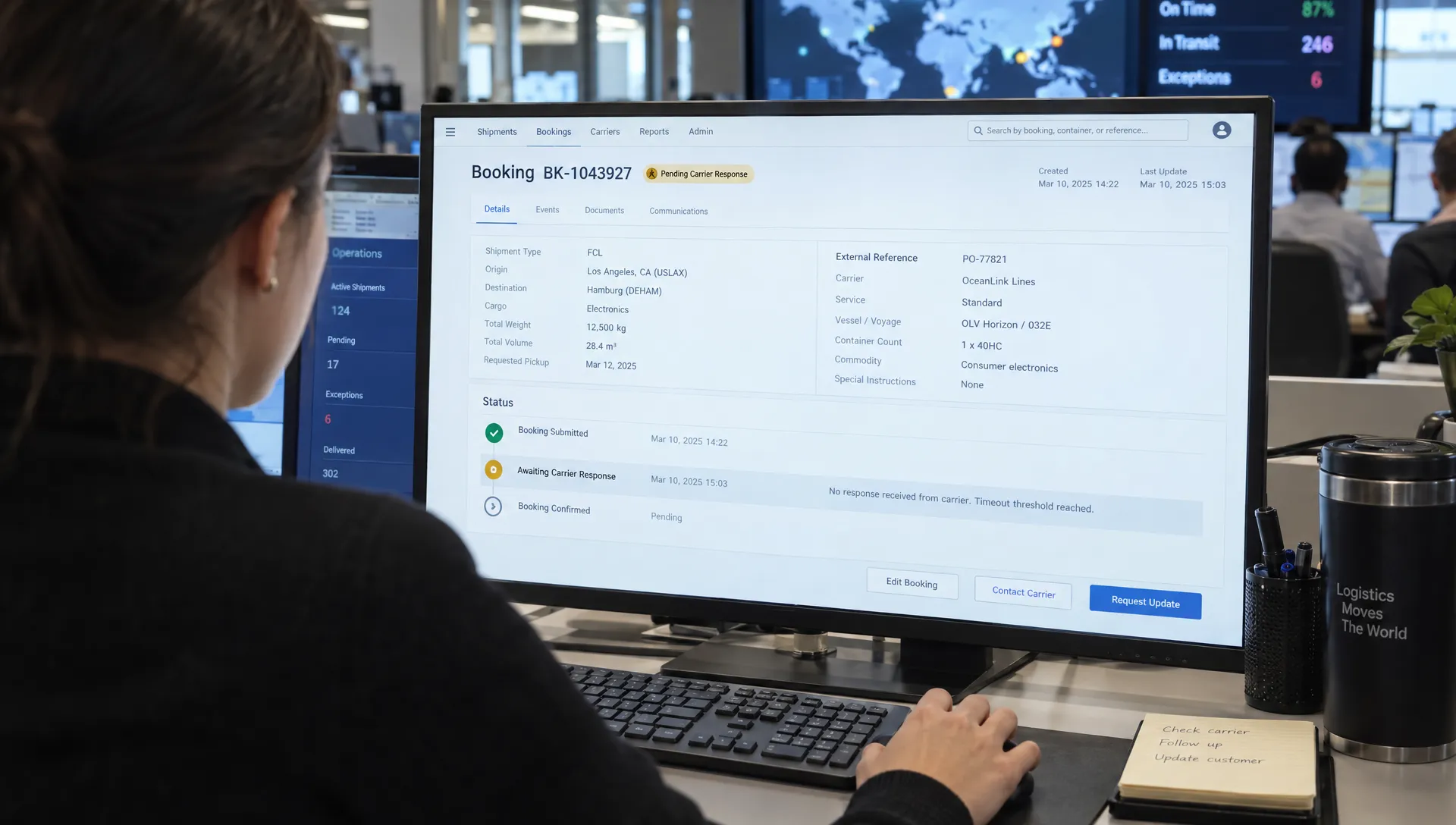
For 3pl fulfillment services, shipment visibility and traceability serve different purposes: a delivery milestone shows movement, while the event history must identify what moved, under which authorization and with which exceptions.
Test backward and forward traceability under exceptions
A provider demonstration should reconstruct both directions. Starting with a shipped serial, identify its lot, inbound receipt, status history and destination. Starting with a restricted lot, identify affected stock, open orders, staged freight and completed deliveries.
Use a controlled pilot containing deliberate exceptions rather than only clean transactions:
Test scenario | Evidence required to pass |
One lot split across several pallets | Every resulting handling unit retains the correct lot association |
Duplicate serial received | The duplicate is blocked and an exception is recorded |
Lot hold applied after allocation | Affected picks and staged shipments cannot proceed without authorized disposition |
Shipment message replayed | No duplicate inventory deduction or shipment confirmation occurs |
Serialized kit partially returned | Returned components retain their original identity and enter the required inspection status |
For kitting, preserve parent-child relationships between the assembled kit and its constituent serialized or lot-controlled components. Document substitutions and disassembly so an affected component can be traced even after the kit’s configuration changes.
A recall exercise for 3pl fulfillment services should produce affected destinations, quantities, serials, lots and unresolved movements, not merely a warehouse stock report. Include goods already tendered to a carrier, where physical containment requires coordination outside the warehouse.
Pro-Tip: Run the trace exercise against an actual pilot shipment and reconcile the result to receiving, inventory and delivery records. A successful database search is not sufficient evidence of end-to-end control.
Specify measurable service levels and exception ownership
Avoid an SLA that compresses every control into “inventory accuracy.” Define separate measures for identifier completeness, status enforcement, event availability and trace-response performance.
Control measure | Contract definition to establish |
Identifier completeness | Required fields populated and validated across the agreed eligible population |
Serial-lot linkage | Units with a valid association to the expected manufacturing lot |
Unauthorized release | Shipment confirmations involving inventory subject to an active restriction |
Event latency | Elapsed time between physical activity and availability in the agreed system |
Trace-response time | Time from an authorized request to a reconciled result with exceptions identified |
Exception aging | Open discrepancies measured from detection to approved disposition |
Set thresholds according to cargo risk and operational requirements rather than adopting an unsupported universal benchmark. A missing serial on a critical replacement controller and a delayed informational milestone have different consequences.
For each failure, name the party authorized to investigate, quarantine, correct data and approve release. Separate administrative correction from physical disposition. A user who can repair a label record should not automatically have authority to release quality-held stock.
The commercial scope for 3pl fulfillment services should also identify charges for unit-level scanning, relabeling, exception research, integration changes, trace exercises and after-hours holds. Otherwise, the quoted handling rate may exclude the controls the operating model depends on.
Validate the scope without assuming every service is bundled
A provider may execute the entire flow or only one segment. Drayage-only, transload-only, air-export execution and air-import customs coordination can each fit a broader operating model, provided the entry and exit evidence is defined.
For a modular engagement, specify what arrives with the cargo, which records the provider creates and what the next party must acknowledge. A drayage carrier may transfer a sealed container without scanning its contents. The control then depends on an intact seal and a reliable upstream contents record, followed by downstream verification.
The operational handoffs between import drayage and domestic fulfillment should therefore be included in the scope discussion, even when different providers perform them.
SHIPIT Logistics offers ocean and air freight, port drayage, cross-dock transloading, warehousing, fulfillment and specialized project-cargo transport. These services can support end-to-end execution or a standalone requirement. The required serial-lot workflow, system interfaces and acceptance criteria should be validated for the specific engagement, not assumed from a general service description.
Before awarding 3pl fulfillment services, request a written control matrix and a pilot using representative identifiers, packaging changes and release exceptions. Evaluate the evidence produced, not just the list of available services.
Frequently Asked Questions
Can a pallet barcode provide serial-lot traceability? Only when the pallet identifier is reliably associated with its contents and those relationships are updated after splits, repacking or transfers. Scanning a pallet without validated contents does not establish unit-level traceability.
Does shipment tracking prove which serial numbers were delivered? Not by itself. Tracking generally records transport milestones. Proof requires a connection between the shipped identifiers, shipment confirmation and delivery evidence, with discrepancies retained for investigation.
What should an RFP for 3pl fulfillment services require? Include the identity model, receiving and release rules, integration responsibilities, freight handoff evidence, exception ownership and measurable acceptance tests. Require a backward-and-forward trace exercise before approving the production workflow.
Share your item and lot structure, freight lanes, release rules and integration requirements with SHIPIT Logistics. Discuss an end-to-end or modular operating scope, then define the evidence and pilot tests needed to validate serial-lot control before live execution.