Cargo Freight Agent Checks for US Air Battery Exports

A cargo freight agent should release a US air battery export only when the physical shipment, dangerous-goods documentation, airline acceptance and export authorization agree. A confirmed booking alone does not establish that the batteries are eligible to fly, that a connection accepts their configuration or that the terminal will receive them before its dangerous-goods cutoff.
For industrial shippers, the expensive failures often begin upstream: an engineering sample classified as a production battery, equipment dispatched with an undocumented spare pack or a supplier’s state-of-charge statement that does not identify the actual shipment. Those gaps can strand cargo after pickup and consume the recovery window for a commissioning deadline or production outage.
Use the following checks as a shipment-release framework. Apply the regulations and carrier variations effective on the departure date, not the requirements attached to a previous booking.
Make the cargo freight agent’s release authority explicit
Separate commercial coordination from regulated functions. The person sourcing capacity may not be the person authorized and trained to classify dangerous goods, prepare packages or sign a Shipper’s Declaration for Dangerous Goods.
Assign a named owner to battery classification, package preparation, declaration approval, airline acceptance, TSA security coordination and export filing. Where a forwarder performs a function, record the scope and authorization. Delegating work does not automatically transfer every regulatory responsibility away from the shipper.
The shipment record should identify the US Principal Party in Interest (USPPI), the party offering the dangerous goods for transportation and the authorized filing agent, where applicable. These roles are related but not interchangeable.
For a standalone export-air assignment, define where responsibility begins and ends: factory pickup, terminal tender, airport-to-airport transport or foreign door delivery. Specify who resolves a rejected package and who can authorize repacking or rebooking costs.
Before pickup, the cargo freight agent should circulate one release record showing each approval owner, supporting evidence and unresolved hold. An email saying “documents look fine” is not an adequate substitute for function-specific signoff.
Classify the exact battery configuration
Classification must follow the goods actually offered, including chemistry, configuration, condition and intended use. The same lithium-ion battery can fall under different packing instructions depending on whether it travels alone, packed with equipment or installed in equipment.
Shipment configuration | Classification checkpoint | Booking consequence |
Standalone lithium-ion cells or batteries | UN 3480, applicable Packing Instruction 965 provisions | Cargo Aircraft Only requirements and state-of-charge controls affect routing |
Lithium-ion batteries packed with equipment | UN 3481, applicable Packing Instruction 966 provisions | Separate batteries accompanying equipment require the correct packaging and charge controls |
Lithium-ion batteries contained in equipment | UN 3481, applicable Packing Instruction 967 provisions | Installation, activation prevention and package conditions must match the instruction |
Lithium-metal batteries, alone or with equipment | UN 3090 or UN 3091, as applicable | Lithium-content limits apply rather than lithium-ion watt-hour thresholds |
Sodium-ion batteries with organic electrolyte | UN 3551 or UN 3552, as applicable | Use the applicable sodium-ion provisions, not a lithium-battery template |
Record cell or battery model, watt-hour rating or lithium content as applicable, quantity, battery net mass and package count. Separate assembled battery systems, battery-powered vehicles and specialized machinery from ordinary replacement-pack workflows because different entries or instructions may apply.
For lithium batteries, match the UN 38.3 test summary to the actual battery type. A safety data sheet does not replace that evidence. The cargo freight agent must escalate prototypes, low-production runs and uncertain battery condition before requesting ordinary airline acceptance.
Prove state of charge and package compliance
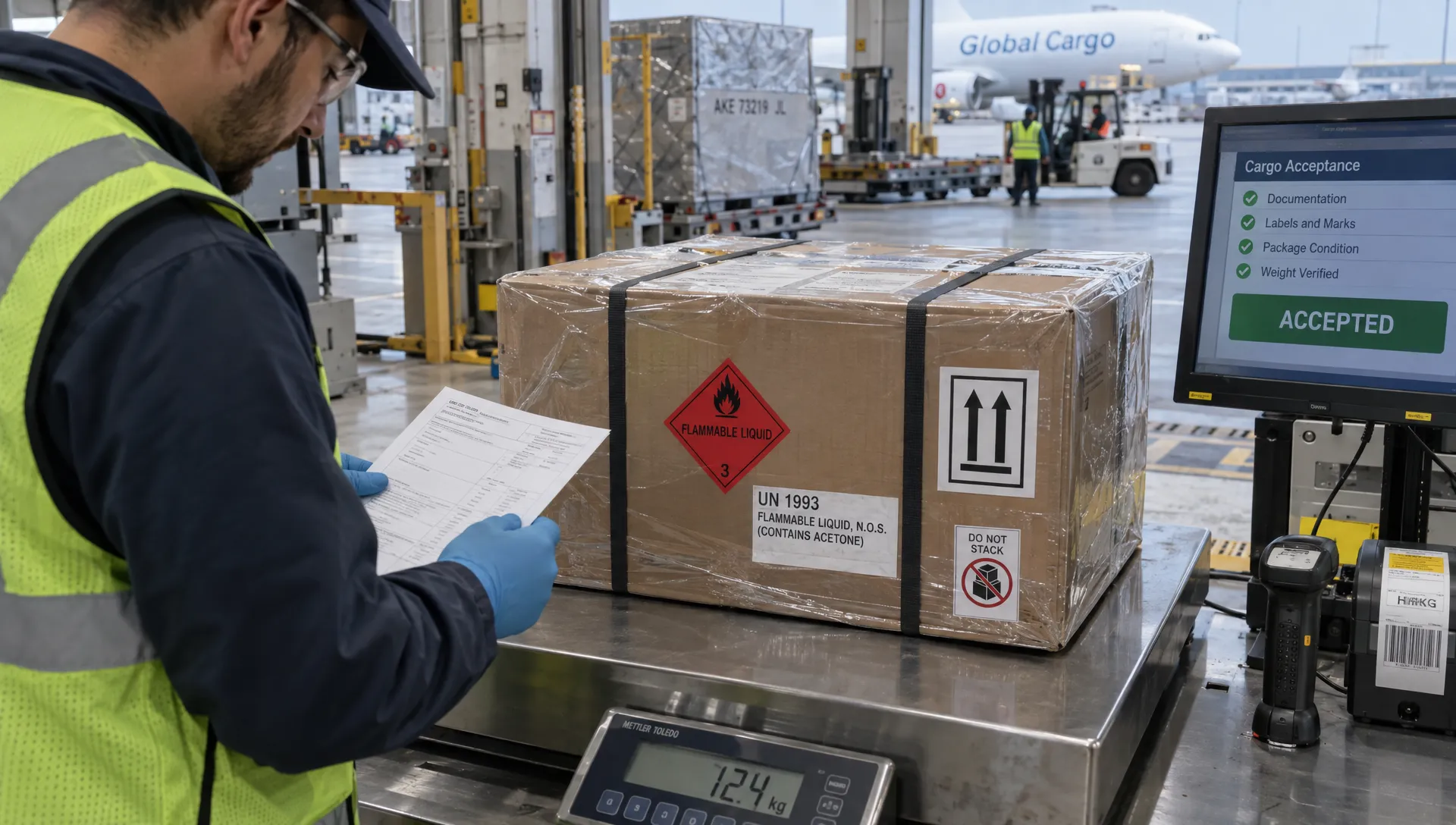
State of charge is an acceptance control, not a descriptive note on the commercial invoice. Establish who measured or controlled it, which battery population the evidence covers and whether anything changed after verification.
Standalone lithium-ion batteries under Packing Instruction 965 generally require a state of charge not exceeding 30%, unless the applicable approval provisions are satisfied. For 2026 departures, Packing Instruction 966 also imposes a 30% limit for lithium-ion batteries packed with equipment, subject to its specific exceptions and approval provisions. Do not automatically apply identical requirements to batteries contained in equipment under Packing Instruction 967.
Have the cargo freight agent reconcile the charge evidence against the applicable instruction and operator requirements before cargo leaves the shipper’s control. “Discharged for shipping” is too vague to support a release decision.
Package verification should address terminal protection, prevention of movement, accidental activation, required packaging performance and applicable quantity limits. Confirm that overpacks do not obscure required marks or labels unless they are reproduced as required. Where a declaration is required, reconcile it with the package markings and air waybill information.
Batteries liable to produce dangerous heat, fire or short circuit because of damage or a safety defect are forbidden for air transport. Returns require condition assessment rather than automatic reuse of the outbound documents.
Pro-Tip: Require package photographs before pickup, including closures, marks, labels and any overpack. Photographs support verification but do not replace inspection, testing evidence or trained preparation.
Obtain acceptance for every air segment
A route sold as an airfreight product can include multiple operating airlines, interline transfers and a road-feeder segment. Acceptance must cover the shipment configuration across the actual route, not simply the first flight number.
Confirm passenger-aircraft versus cargo-aircraft eligibility, origin handling capability, transfer-station restrictions and destination acceptance. Some operators impose restrictions beyond the baseline regulations. A commercially available flight is not necessarily available for the declared battery shipment.
Ask the cargo freight agent to obtain shipment-specific confirmation identifying the UN number, packing instruction, package count, battery quantity or mass as relevant and proposed routing. Record any approval conditions. Preliminary acceptance remains subject to compliant presentation and the operator’s acceptance checks.
For an urgent battery replacement, confirm dangerous-goods receiving hours separately from general cargo hours. Include terminal transfer time, acceptance inspection and the possibility of correction before cutoff. Next Flight Out is not a meaningful recovery commitment if the eligible aircraft departs before the dangerous-goods desk can receive the freight.
A charter may solve a capacity, schedule or loadability problem, but it does not remove dangerous-goods restrictions. When scheduled service cannot meet the requirement, incorporate battery acceptance into the broader US export charter planning process before committing aircraft funds.
Close the US export and security record
The cargo freight agent should keep three approvals distinct: dangerous-goods acceptance, aviation-security compliance and legal authorization to export. Passing one does not satisfy the other two.
For export compliance, establish the correct Schedule B classification, determine the applicable export-control classification and assess destination, end user and end use. Schedule B and an Export Control Classification Number serve different purposes. Neither should be inferred solely from a supplier’s product description.
Determine whether Electronic Export Information is required under the Foreign Trade Regulations. Retain the AES Internal Transaction Number or the applicable exemption citation, along with filing authorization where required. An accepted AES filing does not establish that an export license is unnecessary.
Coordinate pickup and tender through the applicable TSA-compliant security process, including an authorized Indirect Air Carrier where relevant. Confirm screening arrangements compatible with the cargo’s packaging and dangerous-goods status. Do not assume screening can occur at the final minute without affecting acceptance or package integrity.
For foreign door delivery, identify the destination importer, customs-clearance owner and local delivery restrictions before departure. Outbound US clearance does not guarantee destination admissibility. If the commercial arrangement includes a later US return, establish a separate air-import customs and battery-condition workflow rather than reversing the export documents.
Keep modal and handling alternatives executable
A rejected battery air shipment needs a controlled recovery plan. Switching modes, changing the packaging configuration or moving cargo into temporary storage creates new checks rather than eliminating the original ones.
Ocean FCL and LCL alternatives
For replenishment inventory without an immediate line-down consequence, compare air with compliant ocean FCL or LCL service. Reassess the shipment under the applicable IMDG Code provisions, vessel-operator policy and destination requirements. Air documentation is not automatically reusable for ocean carriage.
Standard 20-foot, 40-foot or 45-foot equipment is relevant only where the trade lane, cargo and operator support it. Reefer service should follow a documented temperature requirement, not a blanket assumption that batteries need refrigeration. For LCL, confirm consolidator acceptance and CFS handling capability before routing freight to the station.
Port drayage and controlled storage
If recovery moves to ocean, the cargo freight agent should align the container plan with drayage appointments, terminal receiving windows and equipment-return obligations. A later vessel departure can create storage, demurrage or detention exposure if the truck and container plan remains unchanged.
Transloading or cross-docking belongs in the plan only when it solves a defined problem, such as transferring compliant packages into suitable ocean equipment or avoiding prolonged terminal dwell. Battery acceptance at an ordinary warehouse cannot be assumed. Apply shipment-specific checks when vetting storage services for battery cargo, including permitted quantities, handling conditions and emergency arrangements.
Project cargo and heavy-haul interfaces
For large battery systems or battery-containing machinery, package eligibility and aircraft loadability are separate gates. Verify dimensions, floor loading, center of gravity, lifting provisions and restraint requirements before treating a freighter or charter as a solution.
The ground leg may require specialized trailers, route review or permits even when the international movement is by air. Where ocean OOG or breakbulk becomes the alternative, recalculate lifting, lashing and final-site delivery requirements. Neither a heavy-haul booking nor a vessel reservation establishes battery compliance.
Make tender release auditable
The cargo freight agent should close the file against the exact shipment version presented for carriage. Engineering substitutions, additional spare batteries, replacement cartons and routing changes must trigger review of affected approvals.
A practical release record ties together the battery identity, condition assessment, test-summary reference, applicable charge evidence, package verification, required transport documents, carrier acceptance and export authorization. Record pickup details, terminal cutoff and escalation contacts in the same operational handoff.
Use explicit stop conditions. Missing test evidence, an unexplained configuration change, an unavailable approval or a package discrepancy should prevent tender until the responsible party resolves it. Commercial urgency does not make an incomplete record acceptable.
Pro-Tip: Set an internal release deadline earlier than the airline’s cutoff. Size that buffer around the actual time needed to correct documentation, return cargo or arrange compliant repacking, rather than using a standard buffer for every shipment.
After departure, measure preventable rejection rate, documentation rework, acceptance-to-uplift time and recovery cost. Separate shipper-data failures from carrier changes so corrective action reaches the responsible process. For recurring lanes, retain a controlled shipment template but revalidate the battery model, rules and operator variations for each movement.
Frequently Asked Questions
Can a cargo freight agent sign the dangerous-goods declaration for the exporter? An appropriately trained and authorized party may prepare or sign documents within the applicable regulatory framework and agreed scope. Confirm the signatory’s function-specific training and authority. A booking relationship alone does not establish either, and delegation does not erase the shipper’s applicable responsibilities.
Does a UN 38.3 test summary guarantee airline acceptance? No. It addresses testing evidence for the battery type, not the complete transport decision. Classification, condition, state of charge, packaging, quantity limits, documentation and operator restrictions still require review. Prototypes and other exceptional shipments need their own eligibility assessment.
Can rejected air battery cargo move immediately by ocean instead? Only after ocean-specific eligibility, packaging, documentation and carrier acceptance are confirmed. The revised plan must also address pickup, port drayage and any necessary storage. A shipment rejected because of a safety defect must not simply be redirected to another mode without evaluating the applicable restrictions.
Need to release a US battery export or resolve a routing constraint? Discuss the shipment profile with Shipit Logistics for a defined scope covering standalone export-air execution or a coordinated plan across ocean freight, drayage, approved storage and specialized ground transport, subject to shipment-specific acceptance.