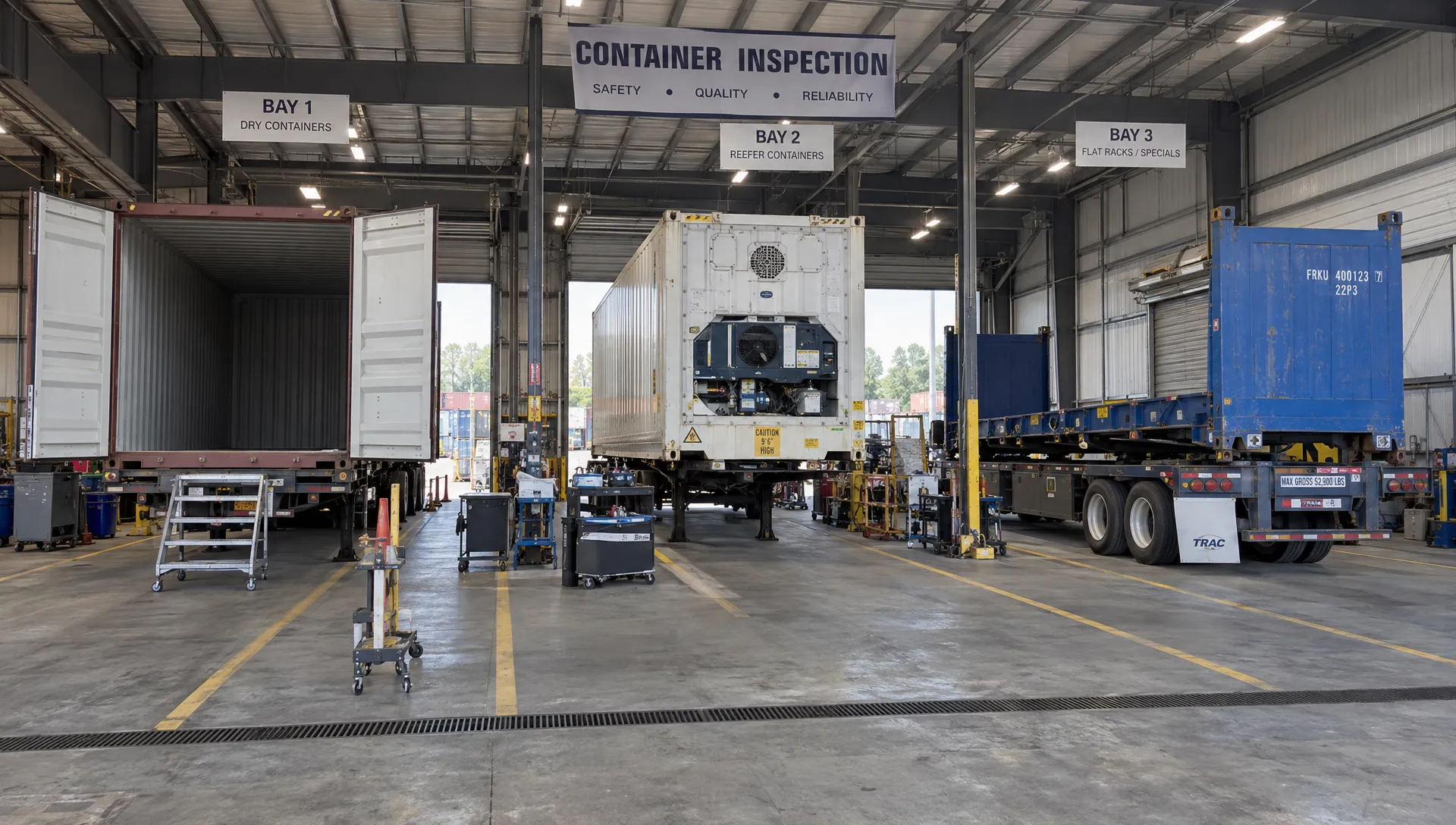
Out-of-Gauge (OOG) Flat Rack Lashing & Surveyor Certification

A rejected flat rack can strand a critical-path machine after fabrication, heavy-haul delivery and crane mobilization are already complete. For out of gauge cargo, booking acceptance is only the first approval gate. The loaded configuration must also satisfy structural limits, engineered securement requirements, lifting clearances and the carrier’s inspection conditions.
Once machinery exceeds a standard container’s dimensional envelope, routine packing assumptions no longer apply. Dynamic forces, concentrated bearing loads and three-dimensional lashing geometry govern the transport design. Exceeding a flat rack’s approved payload, however, is not an OOG exception: it requires different equipment or a different transport solution.
For industrial shippers, the objective is to resolve those constraints before the machine reaches the terminal. Shipit Logistics coordinates project cargo engineering, ocean freight execution and inland transport around that sequence. The engineering package, physical loading arrangement and independent survey must describe the same shipment, not three slightly different versions of it.
Weight distribution and engineered dunnage for out of gauge cargo
Establish equipment-specific structural limits
A 20' or 40' flat rack cannot be selected by nominal length and advertised payload alone. Confirm the assigned unit’s CSC plate, tare, maximum gross mass, condition and carrier-approved concentrated-load restrictions. A longer platform does not automatically provide a higher permissible machinery weight.
A 40-metric-ton stamping press illustrates the problem. Four relatively small machine feet concentrate the entire static load into limited bearing areas. Even where the total mass falls within equipment limits, those feet can overload flooring, cross-members or local structural connections.
Do not place heavy machine feet directly on the deck without an approved bearing assessment. A floor that supports distributed cargo is not automatically suitable for the same mass concentrated beneath four supports.
Design the load path, not just the packing footprint
Engineered dunnage must transfer machinery reactions into the flat rack’s primary longitudinal beams through approved bearing locations. Hardwood sleepers, fabricated steel spreaders or a combined cradle may be appropriate, depending on support geometry and structural calculations.
For out of gauge cargo, the dunnage drawing should identify individual support reactions, bearing areas, member orientation and the load path into the container structure. Specify timber grade or steel section properties rather than leaving material selection to the loading crew.
Check timber bearing and bending, steel deflection, local crushing and differential settlement. An elevated center of gravity also changes overturning demands and may require a wider support arrangement or additional restraint.
Engineering input | Required verification |
Machinery mass and center of gravity | Final shipping condition, including installed accessories and retained fluids |
Support locations | Approved machine bearing points and reactions at each support |
Flat rack structure | Actual equipment limits and acceptable load-transfer locations |
Dunnage arrangement | Bearing pressure, bending, stability and attachment or restraint |
Loaded geometry | Overall dimensions, overhangs and access to lifting and securing points |
Solid-wood dunnage used internationally must also satisfy applicable ISPM 15 treatment and marking requirements. That phytosanitary requirement is separate from structural suitability.
Control friction without treating it as positive restraint
For out of gauge cargo, specialized anti-slip rubber can improve interface friction and prevent direct metal-to-metal contact, but only when its properties suit the actual contact pressure and environment. Verify the material’s friction data, compression behavior and resistance to oil, moisture and expected temperatures.
A pad crushed beyond its approved pressure range can undermine both friction assumptions and support geometry. Similarly, painted, oily or contaminated surfaces cannot be assigned the friction coefficient of clean, dry test specimens.
Mechanical blocking and direct lashings must address the residual forces identified by the securing calculation. Do not credit the same friction resistance twice across different parts of the calculation.
Pro-Tip:
The mechanics of flat rack lashing
Use the MSL rule of thumb only as a screening check
Maximum Securing Load (MSL) is the allowable load capacity assigned to a securing device for cargo-securing purposes. It is not interchangeable with breaking strength. The effective capacity of an assembly is limited by its weakest component, including chains, shackles, turnbuckles, connectors, cargo attachments and flat rack securing points.
A commonly used preliminary rule for out of gauge cargo is that the sum of the MSLs on each opposing side should equal or exceed the cargo’s weight, expressed as force. Apply any carrier-specific interpretation of that rule explicitly.
For a 40-metric-ton unit, static weight is approximately 392 kN. Under that screening convention, each opposing side would require at least 392 kN of aggregate MSL. This is not a statement that the load is adequately secured.
The rule does not resolve unfavorable angles, uneven load sharing, tipping, vertical force components or the strength of attachment points. Nor does it establish that sufficient lashings exist in every required direction. Passing it is a preliminary check, not an engineering release.
Calculate directional resistance and overturning
The securing calculation must address longitudinal, transverse and vertical transport actions using the applicable method, route assumptions and carrier requirements. Include sliding, tipping, blocking capacity and the effects of the cargo’s center-of-gravity height.
For out of gauge cargo, nominal lashing strength can substantially exceed usable directional resistance. For a direct lashing inclined at angle α above horizontal and angle β away from the direction being resisted, its horizontal contribution in that direction is proportional to T × cos α × cos β, where T is the allowable tension adopted by the calculation method.
Do not automatically substitute MSL for T. For example, where the applicable IMO CSS Code Annex 13 method is used, its calculated-strength provisions include CS = MSL/1.5. Apply the complete method consistently rather than mixing its safety factors with another system.
Check overturning moments separately. A restraint arrangement that prevents sliding may still permit a tall press or process skid to tip. Unless justified by the design, do not assume every lashing reaches its allowable tension simultaneously.
Select securing materials by duty and attachment geometry
Ocean freight lashing materials must be traceable, serviceable and compatible with the approved design. Selection should account for sharp edges, elongation, connection geometry, inspection access and the consequences of losing one restraint.
Chains: Appropriate for heavy machinery where high-strength direct restraint and robust abrasion resistance are required. Verify chain grade, MSL, hooks and connectors as one assembly. Use compatible turnbuckles or tensioning devices and positively secure them against loosening.
Wire rope: Useful for engineered direct lashings where routing or required length favors a custom assembly. Specify rope construction, terminations, thimbles and connection hardware. Clip arrangements, spacing and tightening must follow the approved design and manufacturer’s instructions, not dockside convention.
Polyester webbing: Useful where surface protection and controlled contact with finished equipment are priorities. Verify marine acceptance, rated capacity, elongation and chemical compatibility. Provide suitable edge protection and avoid heat, sharp edges or contact conditions that could cut or degrade the webbing.
For out of gauge cargo, mixing materials with different stiffness and elongation requires particular care. A relatively stiff chain can attract load before a more elastic webbing restraint contributes meaningfully; their nominal capacities cannot simply be added without assessing load sharing.
Resolve cross-lashing, direct angles and lifting clearances
Cross-lashing can provide restraint in more than one direction, but a crossed appearance does not demonstrate adequate capacity. Identify which lashings resist each design action and verify their effective angles from the actual anchor coordinates.
Straight, direct lashings should follow the force path assumed in the calculation. Avoid unintended bends around machinery, side-loading hooks or loading flat rack securing points outside their permitted directions. Cargo lifting eyes must not be treated as lashing points unless their suitability for those loads is established.
For out of gauge cargo, protect the carrier’s required clearance around corner fittings, end structures and vessel handling interfaces. Obtain the actual keep-clear envelope rather than assuming a universal clearance distance.
Pro-Tip:
Where a tandem lift is required, use a separate engineered lifting plan covering crane load sharing, rigging geometry, lifting points and ground conditions. A lashing plan does not authorize the lift, and a marine survey certificate does not replace lift engineering.
The mandatory marine surveyor certification
Establish the carrier’s certification requirement before loading
For heavy machinery bookings that require independent certification, the survey is a mandatory acceptance condition. Carriers can reject or hold out of gauge cargo when the required certificate, supporting calculations or loaded configuration is missing or unacceptable. Obtain those conditions in writing before appointing the loading contractor.
An independent marine surveyor, such as the National Cargo Bureau or another organization acceptable to the carrier, examines the completed transport arrangement against the agreed scope. Confirm whether the appointment covers document review, attendance during loading, final inspection or all three.
Shipit Logistics coordinates the survey requirement with the carrier’s booking conditions and the project’s handling sequence. The surveyor should receive drawings and calculations early enough to identify deficiencies before crane time and trucking appointments become sunk costs.
Independent certification is not universally mandated by IMO as one standardized certificate for every OOG shipment. Its mandatory status commonly arises from the carrier’s booking conditions, terminal requirements, project specifications or insurance terms. That distinction belongs in the shipment’s compliance register.
Define what the surveyor must inspect
The survey should reconcile the approved design with the actual equipment, machinery and securement. For out of gauge cargo, small field changes can have material consequences: moving a support, substituting hardware or relocating an anchor can alter the accepted force path.
Inspection area | Evidence to reconcile |
Equipment and mass | Container identification, structural condition, cargo mass and applicable equipment limits |
Weight distribution | Support locations, dunnage construction, contact conditions and machinery position |
Securement | Lashing arrangement, hardware markings, attachment suitability, edge protection and tensioning |
Handling geometry | Final dimensions, corner-fitting access, lifting clearances and relevant overhangs |
Documentation | Approved drawings, calculations, material records, photographs and outstanding conditions |
The surveyor does not automatically perform every engineering calculation. Establish who prepares the securing design, who reviews structural adequacy and who accepts deviations. Physical attendance cannot compensate for missing design inputs.
A Lashing Certificate, Certificate of Approval or similarly titled report records the surveyed arrangement and the surveyor’s findings within the stated scope. Resolve qualifications and exceptions before relying on it for cargo release.
Tie certification to the correct IMO framework
The IMO cargo-securing framework includes the Code of Safe Practice for Cargo Stowage and Securing (CSS Code). The IMO/ILO/UNECE CTU Code provides complementary guidance for packing and securing cargo in cargo transport units.
For out of gauge cargo, the compliance package should identify which provisions and calculation method were applied. Under IMO Regulations, the relevant SOLAS cargo-securing obligations and the vessel’s approved Cargo Securing Manual also matter. Distinguish mandatory requirements from codes of practice and carrier-specific acceptance criteria.
The certificate supports acceptance of the cargo’s surveyed transport condition. It is not an unconditional guarantee of seaworthiness, an approval of every subsequent handling operation or a replacement for the master’s and carrier’s acceptance.
Likewise, a Verified Gross Mass declaration establishes the packed container’s gross mass for SOLAS purposes; it does not certify load distribution or lashing adequacy.
Close the release gate before terminal delivery
Release the shipment only after the required survey findings are closed, the carrier has received its specified documents and the final dimensions match the booking. Retain photographs showing support interfaces, individual securing arrangements, hardware identification and unobstructed handling points.
Any material change after inspection should trigger review and, where necessary, reinspection. Replacing a chain, moving the machine or altering dunnage can invalidate the basis of the marine surveyor certificate.
Shipit Logistics can coordinate heavy lift logistics as an end-to-end project or provide a defined service segment. Where loading occurs at an off-dock facility, assign responsibility for the loaded flat rack’s road movement, terminal appointment and preservation of securement. The separate planning requirements for OOG reload permits remain relevant even after the ocean arrangement is approved.
If the required bearing structure, securing geometry or handling clearance cannot be achieved, revisit the equipment strategy. Comparing flat racks with breakbulk vessel options is preferable to forcing an unworkable load through terminal acceptance.
Frequently asked questions
Does every out of gauge cargo shipment require an independent survey? Requirements vary by carrier, cargo and booking conditions. For heavy machinery, establish the survey scope and acceptable issuing organization before loading. Where certification is required, treat it as a release gate rather than a document to obtain afterward.
Does meeting the total-MSL rule prove the lashing is adequate? No. It is a preliminary screening convention. The accepted design must also address directional resistance, load sharing, sliding, overturning, attachment strength and the applicable calculation method.
Can a lashing certificate authorize cargo above the flat rack’s payload limit? No. Survey certification does not override structural limits, approved gross mass or carrier restrictions. Use suitable equipment, an expressly approved alternative arrangement or another shipping method.
Planning a heavy-machinery shipment on 20' or 40' flat racks? Engage Shipit Logistics before loading to coordinate equipment acceptance, engineered dunnage, flat rack lashing and independent survey requirements, either within an end-to-end project move or as a defined service scope.