The Ultimate Guide to Ocean ISO Container Specifications

The universal language of ISO 6346
Precision in ocean container dimensions determines whether an industrial shipment clears the door frame, remains within structural ratings and moves legally beyond the terminal. Equipment selection must reconcile the cargo envelope, center of gravity, concentrated loads and handling method with the actual container supplied. A nominal equipment description is not sufficient authorization to load.
ISO 6346 standardizes container identification, size and type coding. It does not, by itself, establish every dimensional tolerance or authorize a particular commodity. ISO 668 addresses classification, external dimensions and ratings, while the ISO 1496 series addresses specifications and testing for different container types. The CSC safety approval plate, equipment markings and operator's technical sheet remain essential shipment-level references.
For example, 45G1 identifies a 40-foot high-cube general-purpose container, not a 45-foot container. The first two characters describe size characteristics; the final two describe equipment type. Commercial abbreviations such as HC, HQ and HR are useful booking shorthand but are not interchangeable with formal codes. The Bureau International des Containers size and type reference supports code verification.
Pro-Tip:
Standard dry containers: general-purpose equipment
For standard equipment, ocean container dimensions should be evaluated alongside door clearance and weight distribution, not merely nominal CBM. Dense minerals, machinery parts and cable reels can exhaust payload or floor-loading limits long before occupying the available cube.
The tables below present the reference specifications in both Metric and Imperial units. Internal length, width and height appear on separate rows for easier reading on mobile devices. CBM means cubic meters and CFT means cubic feet. These are planning values, not guaranteed fleet specifications: internal dimensions, door openings, tare and ratings vary by manufacturer and series.
20' Standard Dry (22G1)
Booking shorthand: 20' DV / 20' DC. The 20-foot unit suits dense replacement parts, fasteners and industrial feedstocks.
Specification | Metric | Imperial |
Internal length | 5.90 m | 19' 4 1/4" |
Internal width | 2.35 m | 7' 8 1/2" |
Internal height | 2.39 m | 7' 10 1/4" |
Capacity | 33.2 CBM | 1,172 CFT |
Max gross weight | 30,480 kg | 67,200 lbs |
Tare weight | 2,300 kg | 5,070 lbs |
Max payload | 28,180 kg | 62,130 lbs |
40' Standard Dry (42G1)
Booking shorthand: 40' DV / 40' DC. Standard 40-foot units support longer assemblies and palletized components.
Specification | Metric | Imperial |
Internal length | 12.03 m | 39' 5 5/8" |
Internal width | 2.35 m | 7' 8 1/2" |
Internal height | 2.39 m | 7' 10 1/4" |
Capacity | 67.7 CBM | 2,390 CFT |
Max gross weight | 32,500 kg | 71,650 lbs |
Tare weight | 3,750 kg | 8,265 lbs |
Max payload | 28,750 kg | 63,385 lbs |
40' High Cube (45G1)
Booking shorthand: 40' HC / 40' HQ. High cubes suit lower-density cargo, tall crates and consumables that require additional vertical clearance.
Specification | Metric | Imperial |
Internal length | 12.03 m | 39' 5 5/8" |
Internal width | 2.35 m | 7' 8 1/2" |
Internal height | 2.69 m | 8' 9 7/8" |
Capacity | 76.4 CBM | 2,698 CFT |
Max gross weight | 32,500 kg | 71,650 lbs |
Tare weight | 3,900 kg | 8,598 lbs |
Max payload | 28,600 kg | 63,052 lbs |
Some lanes also offer 45-foot high-cube equipment, commonly booked as 45' HC / 45' HQ with ISO code L5G1. Availability, inland compatibility and the assigned unit's complete specifications require lane-specific confirmation.
Payload, door clearance and usable cube
When converting ocean container dimensions into a load plan, separate geometric capacity from legally transportable cargo weight. For the 20' Standard Dry reference above, maximum gross weight is 30,480 kg | 67,200 lbs and tare is 2,300 kg | 5,070 lbs, leaving 28,180 kg | 62,130 lbs for cargo, packaging, dunnage and securing materials. A heavier container with the same gross rating provides less payload.
Allowable cargo mass is constrained by the lowest applicable limit: container rating, floor loading, carrier acceptance, chassis capacity, axle distribution or route restrictions. Neither container length nor the ISO type code guarantees a particular payload.
Door openings are smaller than the internal cargo envelope. Verify the assigned unit's clear door width and height, including the frame, sill and locking hardware. A crate that fits inside may still be impossible to insert.
Internal CBM also overstates usable capacity when cargo requires forklift access, bracing, non-stackable positions or clearance around sensitive equipment. For LCL, the consolidator's receiving and handling limits can be more restrictive than the ocean container itself.
Temperature-controlled freight: reefers
Reefer ocean container dimensions reflect insulated walls, machinery intrusion and airflow infrastructure. A dry-container load plan cannot be transferred directly to refrigerated equipment, even when external dimensions match.
20' Refrigerated (22R1)
Booking shorthand: 20' RF.
Specification | Metric | Imperial |
Internal length | 5.45 m | 17' 10 5/8" |
Internal width | 2.29 m | 7' 6 1/8" |
Internal height | 2.27 m | 7' 5 3/8" |
Capacity | 28.3 CBM | 1,000 CFT |
Max gross weight | 30,480 kg | 67,200 lbs |
Tare weight | 3,080 kg | 6,790 lbs |
Max payload | 27,400 kg | 60,410 lbs |
40' High Cube Refrigerated (45R1)
Booking shorthand: 40' HR / 40' RQ.
Specification | Metric | Imperial |
Internal length | 11.58 m | 38' 0" |
Internal width | 2.29 m | 7' 6 1/8" |
Internal height | 2.53 m | 8' 3 5/8" |
Capacity | 67.3 CBM | 2,377 CFT |
Max gross weight | 34,000 kg | 74,960 lbs |
Tare weight | 4,480 kg | 9,880 lbs |
Max payload | 29,520 kg | 65,080 lbs |
These are reference values. Machinery configuration and insulation design affect internal length, door clearance and tare. A reefer's heavier construction can reduce payload relative to a dry container with the same maximum gross rating. Compare the actual gross ratings rather than assuming every reefer carries less cargo mass.
Airflow, electrical continuity and monitoring
Bottom-air delivery through the T-floor requires an unobstructed return-air path. Respect the marked load line, avoid blocking floor channels and follow commodity-specific stowage instructions. Packaging ventilation and pallet arrangement must support the intended airflow rather than simply maximize pallet count.
For temperature-sensitive reagents, specialty chemicals or industrial materials, document the setpoint, ventilation setting where relevant, acceptable excursions and monitoring responsibilities. A machinery controller reading is not automatically equivalent to product temperature. Define logger placement and retrieval before stuffing.
When planning ocean container dimensions around tall loads, preserve the required airflow clearance above the cargo. Apparent spare height is not necessarily usable stowage space.
Pro-Tip:
Specify a compatible genset for unpowered drayage legs when continuous refrigeration is required. Coordinate fuel endurance, terminal plug-in arrangements, alarm escalation and receiving-site power. Transloading refrigerated cargo is appropriate only when the facility and transfer procedure can maintain the required conditions.
Specialized and out-of-gauge equipment
Open top: overhead-loading access
An open top container supports overhead loading of machinery, fabricated assemblies and other cargo that cannot pass through standard doors. Shore-crane or facility-crane loading still requires an approved lifting arrangement, sufficient working clearance and confirmed equipment availability.
20' Open Top (22U1)
Booking shorthand: 20' OT.
Specification | Metric | Imperial |
Internal length | 5.89 m | 19' 4" |
Internal width | 2.31 m | 7' 7" |
Internal height | 2.35 m | 7' 8 1/2" |
Capacity | 32.2 CBM | 1,137 CFT |
Max gross weight | 30,480 kg | 67,200 lbs |
Tare weight | 2,350 kg | 5,180 lbs |
Max payload | 28,130 kg | 62,020 lbs |
40' Open Top (42U1)
Booking shorthand: 40' OT.
Specification | Metric | Imperial |
Internal length | 12.02 m | 39' 5 1/4" |
Internal width | 2.31 m | 7' 7" |
Internal height | 2.35 m | 7' 8 1/2" |
Capacity | 65.5 CBM | 2,313 CFT |
Max gross weight | 32,500 kg | 71,650 lbs |
Tare weight | 3,850 kg | 8,490 lbs |
Max payload | 28,650 kg | 63,160 lbs |
Open-top loading and protrusion checks
For crane loading, ocean container dimensions must include the clear roof opening, not just the internal floor envelope. Top rails, corner structures and removable header arrangements can restrict insertion. Confirm the assigned unit's opening dimensions before fabricating a crate or spreader arrangement.
Tarpaulin bows support the cover and influence available height. Over-height machinery may require bow removal and an alternative weather-protection arrangement, subject to operator approval. Cargo above the equipment envelope is OOG and requires explicit booking acceptance, including protrusion measurements and vessel stowage review.
Do not assume removing a roof eliminates width restrictions or permits side loading. Open-top sidewalls remain structural boundaries. Likewise, a tarpaulin does not provide the environmental protection of a rigid roof. The listed CBM and CFT describe the reference internal volume, not an approved allowance for protruding cargo.
Pro-Tip:
Flat rack: fixed and folding ends
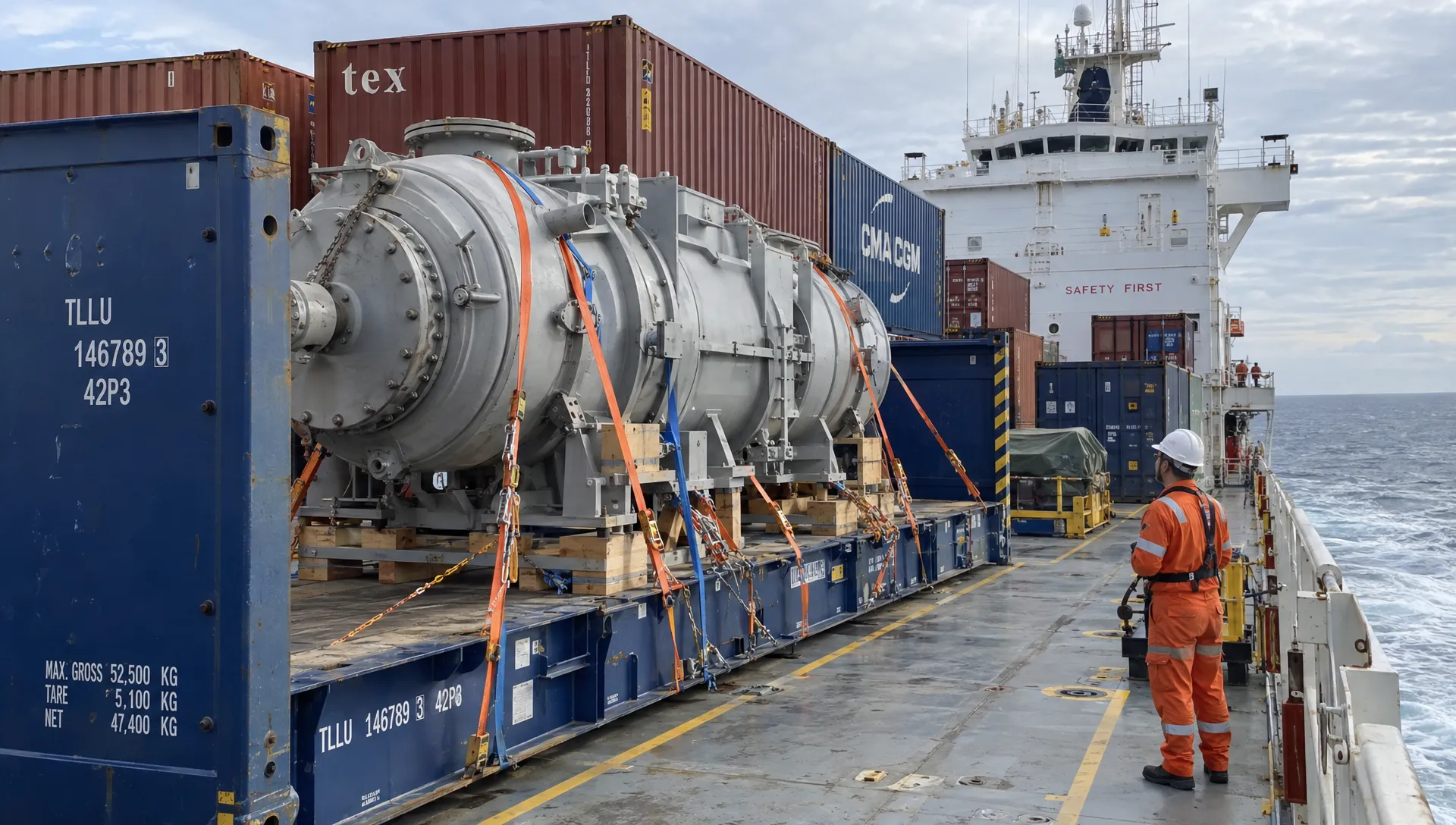
Flat racks accommodate wide machinery, skids and heavy industrial assemblies requiring access unavailable in enclosed equipment. End-frame design affects usable length, lifting access and the acceptable cargo position.
The reference dimensions below describe the internal loading envelope. Confirm usable deck space and clearances on the assigned unit. No CBM or CFT capacity is listed for flat racks: out-of-gauge cargo must be assessed by its actual dimensions, support arrangement and weight.
20' Flat Rack (22P1 / 22P3)
Booking shorthand: 20' FR. Code 22P1 identifies fixed complete ends; 22P3 identifies folding complete ends.
Specification | Metric | Imperial |
Internal length | 5.70 m | 18' 8 3/8" |
Internal width | 2.40 m | 7' 10 1/2" |
Internal height | 2.26 m | 7' 5" |
Max gross weight | 34,000 kg | 74,950 lbs |
Tare weight | 2,530 kg | 5,570 lbs |
Max payload | 31,470 kg | 69,380 lbs |
40' Flat Rack (42P1 / 42P3)
Booking shorthand: 40' FR. Code 42P1 identifies fixed complete ends; 42P3 identifies folding complete ends.
Specification | Metric | Imperial |
Internal length | 11.83 m | 38' 9 3/4" |
Internal width | 2.22 m | 7' 3 3/8" |
Internal height | 1.98 m | 6' 6" |
Max gross weight | 45,000 kg | 99,200 lbs |
Tare weight | 5,700 kg | 12,560 lbs |
Max payload | 39,300 kg | 86,640 lbs |
Flat-rack support, securing and acceptance
Raised-end height and usable deck dimensions vary, including standard-height and high-cube designs. End structures can reduce clear loading length. Do not treat external width as guaranteed clearance between posts or fittings.
For flat racks, ocean container dimensions are only one part of acceptance. Flat rack payload depends on the individual unit's rating and the approved load distribution. A concentrated machinery footprint may exceed local structural limits even when total cargo mass is below the listed payload.
For the 40' Flat Rack reference above, 45,000 kg | 99,200 lbs maximum gross weight minus 5,700 kg | 12,560 lbs tare leaves 39,300 kg | 86,640 lbs maximum payload. That allowance includes packaging and securing materials and does not establish whether a particular machine can be supported safely.
Specify support positions, bearing areas, center of gravity and engineered load-spreading members. Lashing points have defined capacities and permissible load directions. The securing design must address longitudinal, transverse and vertical forces using suitable restraints, blocking and friction assumptions. The IMO/ILO/UNECE CTU Code provides cargo-packing and securing guidance.
Out of gauge shipping also consumes vessel space beyond the booked footprint. Overwidth, overheight, adjacent-slot interference and lifting access can affect acceptance and pricing. Folding ends do not automatically authorize loaded carriage with the ends collapsed.
Platforms: 20' PL and 40' PL
Platforms remove the end walls entirely, providing access for long assemblies and cargo unsuitable for conventional flat-rack end structures. Booking shorthand is 20' PL or 40' PL, with ISO codes 22P0 and 42P0, respectively.
Platform deck height, usable bearing surface, tare and maximum gross rating are equipment-specific. Obtain the assigned platform's dimensions and weight specifications in both unit systems before approving the load plan. No enclosed CBM figure meaningfully describes its capacity.
When assessing platform ocean container dimensions, include the loaded footprint, lifting arrangement and underside clearance. Heavy point-loads require structural review of the platform and any supporting grillage. The absence of end walls does not create unlimited support capacity or eliminate longitudinal restraint requirements.
Some breakbulk parcels move on container vessels using carrier-engineered platform arrangements. Multiple platforms must not be treated as an improvised bridge without an approved support and securing design. Where containerized options impose excessive structural or dimensional constraints, compare a dedicated breakbulk shipping arrangement.
The inland plan must be engineered separately. Terminal handling limits, chassis selection, axle loads, bridge restrictions and final-mile access can invalidate an otherwise acceptable vessel arrangement. Cross-docking onto a suitable heavy-haul trailer may resolve a constraint, but introduces another lift and requires an approved handling location.
Bulk liquid and gas logistics: ISO tanks
20' ISO Tank (22T1): volume and weight specifications
Booking shorthand: 20' TK. This reference tank uses a standard 20-foot frame. Its specifications below focus on nominal liquid volume and weight rather than internal cargo dimensions or enclosed CBM. Gallons are U.S. gallons.
Specification | Metric | Imperial |
Nominal capacity | 26,000 Liters | 6,868 Gallons |
Max gross weight | 36,000 kg | 79,365 lbs |
Tare weight | 3,640 kg | 8,025 lbs |
Max payload | 32,360 kg | 71,340 lbs |
These figures describe the reference unit, not every tank bearing the same size/type code. Vessel capacity, insulation, fittings, tare and pressure rating depend on the tank design.
Tank codes and specification boundaries
For tank equipment, ocean container dimensions describe the frame envelope, not the allowable product, working pressure or filling quantity.
Equipment or classification | Formal ISO code | Operational interpretation |
20' liquid tank | 22T1 | Non-dangerous-liquid tank classification |
20' liquid tank | 22T2 | Another non-dangerous-liquid pressure classification, not a generic hazardous-cargo code |
20' dangerous-liquid tank classifications | 22T3, 22T4, 22T5, 22T6 | Dangerous-liquid classifications distinguished by pressure characteristics |
20' gas tank classifications | 22T7, 22T8, 22T9 | Gas classifications requiring tank-specific verification |
Code correction: The range 22T2 through 22T6 must not be described collectively as hazardous-liquid and pressurized-gas equipment. T2 belongs to the non-dangerous-liquid group; gas classifications use different type designations.
ISO 6346 container codes also must not be confused with IMDG portable tank instructions such as T11. The ISO size/type marking does not establish chemical compatibility or satisfy the shipment's portable-tank instruction. Verify the cargo classification, tank approval, inspection status, pressure limits and required fittings independently.
Capacity, surge control and thermal management
Nominal capacity is not the permitted loading quantity. For the reference tank, 26,000 Liters | 6,868 Gallons describes nominal volume, while 32,360 kg | 71,340 lbs describes maximum payload. Density, thermal expansion, allowable filling degree and gross mass determine the usable load.
Liquid sloshing introduces dynamic forces during braking, cornering and vessel motion. Evaluate partial-fill restrictions under the applicable IMDG provisions and tank approval. Baffle configurations can influence surge behavior, but require confirmation for the actual unit; do not assume every tank is baffled or that one universal minimum fill applies.
When translating ocean container dimensions into tank payload planning, use product mass rather than nominal volume alone. A dense liquid can reach the weight limit before filling the tank. Container structural acceptance would not automatically make that movement legal on a U.S. road route.
Steam coils or other heating arrangements require compatible connections, temperature limits and an agreed heating procedure. Establish insulation needs, viscosity limits for discharge and whether the receiver can provide the necessary utilities.
Cleaning records and inland restrictions
Require a cleaning certificate that identifies the tank and cleaning event, then assess prior cargo, product compatibility and any food-grade or dedicated-service requirements. A cleaning certificate is not proof of compatibility by itself. Inspection certificates and valve condition require separate review.
Dense liquids can produce restrictive axle loads even within the tank's gross rating. Compared with dry vans carrying lower-density goods, tank moves often require closer chassis and route coordination. Confirm permits where available, terminal access and receiving-site restrictions before dispatch.
For shipment-specific acceptance and documentation, apply the additional ISO tank shipping controls for chemical cargo. SOLAS verified gross mass must include the packed container's full mass, not just the liquid quantity.
Frequently asked questions
Are ocean container dimensions identical across every carrier? External dimensions follow standardized size classes, but internal clearances, tare, floor construction, door openings and available fittings vary. Use the assigned unit's technical sheet for critical-fit or concentrated-load cargo.
Does an ISO code establish the container's payload? No. The code identifies size and type characteristics. Confirm marked maximum gross mass, actual tare, structural loading limits and the applicable carrier, chassis and road restrictions.
Can cargo fit inside a container but still require special equipment? Yes. Door clearance, insertion geometry, lifting access or floor loading can prevent enclosed-container loading even when the final cargo envelope fits internally.
Why are flat-rack capacities not listed in CBM or CFT? Enclosed volume is not a useful acceptance measure for out-of-gauge cargo. The actual loaded dimensions, support footprint, center of gravity and approved weight distribution determine suitability.
Is 22T1 equivalent to an IMDG tank instruction? No. 22T1 is an ISO size/type designation. IMDG portable tank instructions and special provisions are separate requirements that must be checked against the specific product and approved tank.
Send your cargo drawings, packed dimensions, weights, center of gravity and origin-to-destination route to Shipit Logistics. Request end-to-end execution or a defined standalone scope, including ocean equipment selection, port drayage, operationally necessary transloading or engineered project-cargo transport.