Ocean Freight Exports: Navigating Container Return Windows and ERDs

The High Cost of the Export Return Window
Effective ocean freight export management requires controlling when equipment leaves the depot, not just securing vessel space. Exporters face a costly conflict: load containers early to release warehouse capacity, or hold freight until the receiving window stabilizes and risk compressing loading, trucking and terminal delivery into a few shifts.
An Earliest Return Date (ERD) pushback turns that conflict into an equipment exposure problem. The container is loaded, the chassis remains occupied and the marine terminal or inland rail ramp will not accept the box. Where early receiving is permitted, acceptance may carry storage charges rather than solve the cost problem.
The operating objective is to synchronize empty release, loading, receiving eligibility and cargo cutoff. A vessel booking alone does not establish that synchronization, and an appointment does not override a closed receiving window.
Vessel Schedules vs. Rail Ramp Schedules: Why Dates Change
Port Terminal Returns: Follow the Receiving Facility
Marine terminal receiving windows move with vessel operations. Weather disruption, port congestion delays, berth availability and changes to the vessel rotation can shift the working schedule. The carrier's revised departure estimate may appear before the terminal updates its receiving instructions, or vice versa.
For ocean freight export management, the critical distinction is between a published sailing estimate and authorization to deliver a specific booking to a specific facility. Dispatch needs both, reconciled against the same vessel, voyage and terminal.
Check whether the displayed ERD applies to dry containers, reefers, hazardous cargo or out-of-gauge equipment. Special cargo may have separate acceptance conditions or narrower receiving periods. A general export receiving notice is not sufficient evidence that the terminal will accept every equipment type.
Track the cargo cutoff, shipping instruction deadline and verified gross mass deadline separately. An ERD pushback does not necessarily move every downstream deadline by the same interval. Use the ocean shipment cutoff and documentation checklist to keep documentary readiness separate from physical receiving eligibility.
Inland Rail Ramp Returns: Validate the Inland Window Independently
For inland rail routings, often managed under IPI arrangements, the rail receiving window follows train departures, railcar availability, ramp capacity and the applicable carrier or railroad instructions. Some lanes operate with windows as tight as 48 hours. That is a lane-specific operating condition, not a universal allowance.
A marine terminal ERD does not authorize an inland rail ramp container return. Conversely, a ramp accepting a container does not establish that the planned train connection or vessel connection remains intact.
Strong ocean freight export management therefore maintains separate inland and marine milestones. Confirm the inland receiving opening, inland cutoff, booking acceptance and any equipment restrictions directly with the relevant operating parties. Do not substitute the vessel's estimated departure for the ramp's delivery deadline.
Pro-Tip: Before releasing a truck to an inland ramp, reconcile the ocean carrier's inland instructions with the ramp's current acceptance status. Escalate conflicting dates in writing rather than asking the driver to resolve them at the gate.
The Financial Trap of ERD Pushbacks
One Schedule Change Can Activate Several Cost Clocks
The exposure begins when an exporter authorizes an empty Pre-pull, loads the container and then loses the planned return opportunity. Carrier equipment remains outside the accepted interchange point, the chassis stays committed and the loaded unit needs a lawful, secure parking location.
These charges do not necessarily share a free-time allowance, billing calendar or stop event. A waiver from the ocean carrier does not automatically eliminate chassis rental or third-party yard charges.
In ocean freight export management, cost attribution must follow each contract rather than treating every delay charge as terminal demurrage.
Exposure | What to verify before dispatch | Effect of an ERD pushback |
Per Diem / detention | Export equipment free time, start event, tiered rates and contractual stop event | The loaded box may remain outside the receiving facility beyond its allowance |
Chassis daily usage | Rental terms, billing calendar and authorized return location | Daily charges can continue while the container waits |
Loaded-container yard storage | Daily storage, lift charges, access terms and cargo restrictions | An off-terminal holding location becomes necessary |
Export Demurrage / terminal storage | Receiving rules, terminal tariff and carrier contract | Early acceptance or extended terminal dwell may generate charges under applicable terms |
Failed delivery or rescheduling | Trucking accessorial schedule and appointment rules | Rejected delivery can add dry-run, waiting or rehandling costs |
Do not label all export demurrage fees as unavoidable consequences of a delayed vessel. A box waiting outside the terminal normally creates a different charge pattern from one already accepted inside it. Invoice descriptions should be reconciled with actual custody and gate events.
Calculate Incremental Exposure Before Choosing a Recovery Move
Consider an illustrative scenario, not a market rate quotation. A loaded container faces three additional chargeable days after an ERD shift, with all applicable allowances already exhausted:
Illustrative charge | Daily amount | Additional chargeable days | Incremental cost |
Carrier equipment detention | $125 | 3 | $375 |
Chassis usage | $45 | 3 | $135 |
Loaded-container yard storage | $60 | 3 | $180 |
Total | $230 | 3 | $690 |
For eight containers under those same assumptions, exposure reaches $5,520, before extra lifts, failed deliveries or reefer power. Actual chargeable days must be calculated separately for each provider, including weekends, holidays and tier changes where applicable.
This calculation makes ocean freight export management decisions concrete: compare the expected holding cost with an approved early-return charge, a different receiving option or a cargo-staging alternative. Include the probability of another schedule change rather than assuming the revised ERD is final.
A pre-pull container costs review should also capture loading labor already committed and the operational cost of occupying chassis needed for other moves.
Pro-Tip: Build an exposure ledger by container number. Record empty interchange time, equipment free-time expiry, chassis terms, yard charges and the next permitted receiving opportunity. A shipment-level total can conceal containers approaching a higher detention tier.
Strategic ocean freight export management: Mitigating Costs and Tracking Schedules
Replace Static Booking Confirmations With a Live Control Record
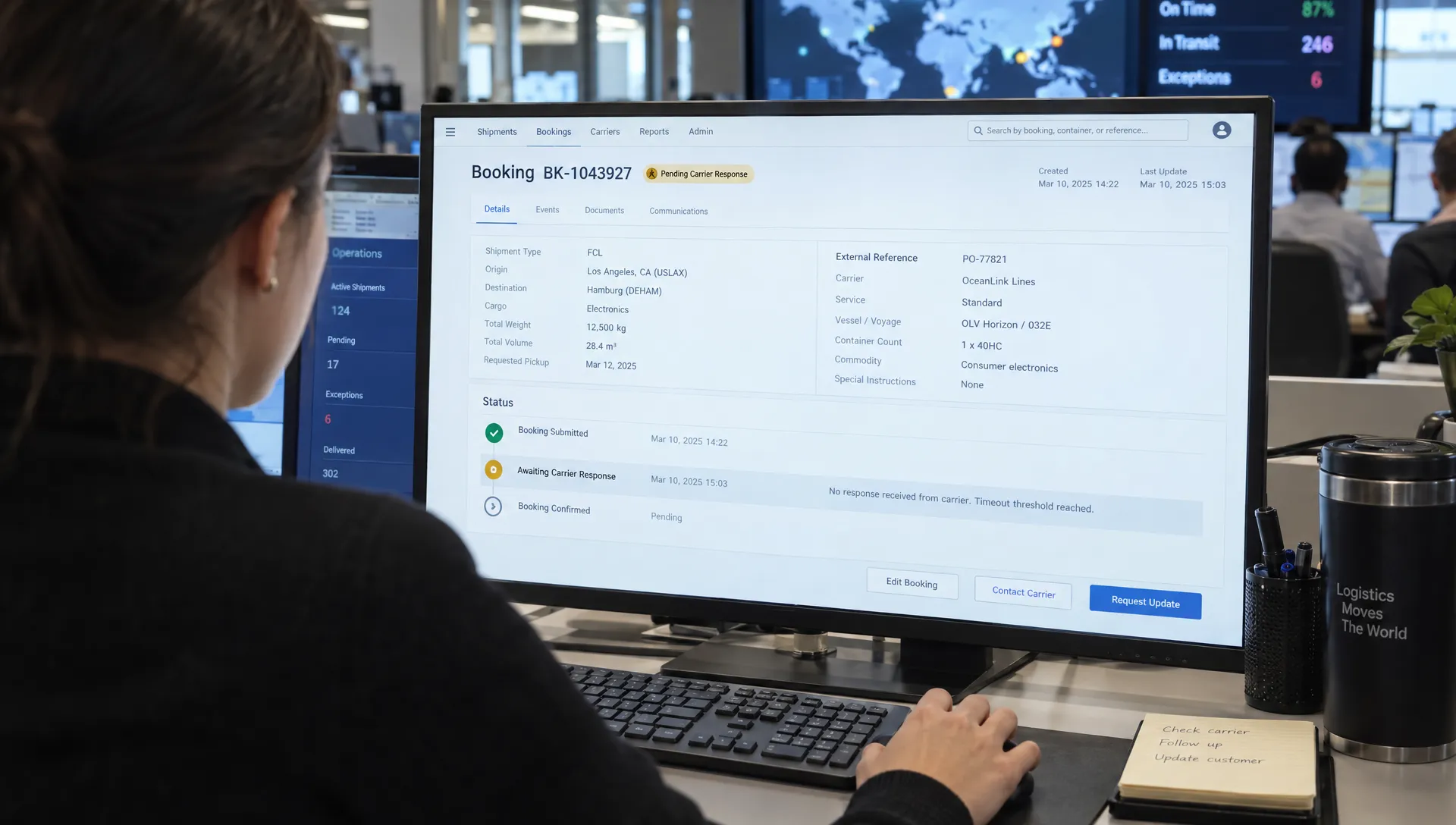
Treat the booking confirmation as the starting instruction, not the dispatch authority. Conduct daily vessel schedule tracking and check the terminal website or rail acceptance system. Recheck immediately before empty pickup, loading commitment and loaded delivery when schedules are unstable.
The control record should identify the source, timestamp and person responsible for each update. Retain prior versions so the team can reconstruct what was known when equipment was released.
At minimum, keep these fields together:
Receiving eligibility: Current ERD, facility, applicable cargo category and any early-receiving approval.
Delivery feasibility: Cargo cutoff, gate hours, appointment status and relevant holiday closures.
Equipment exposure: Empty pickup authorization, carrier free-time expiry, chassis terms and available holding capacity.
Change ownership: Named carrier, forwarder, warehouse and drayage contacts, with an escalation owner for conflicting instructions.
The value of ocean freight export management lies in acting on changes, not merely recording them. A revised ERD should trigger a release review, a new cost forecast and a dispatch decision.
Set the monitoring frequency around exposure. A shipment still staged as loose freight may tolerate a daily review. Loaded containers nearing free-time expiry require event-driven communication and checks before each committed movement.
Stage Cargo Before Committing Equipment
Where warehouse capacity permits, stage export cargo on the floor until the receiving window is confirmed against current operating instructions. This preserves flexibility without starting the container equipment clock prematurely. No future receiving date is guaranteed, so confirmation reduces risk rather than eliminating it.
Calculate the latest practical empty pickup by working backward from the intended gate appointment. Include depot availability, chassis sourcing, loading duration, inspection, sealing, scale access and driver availability. Leave enough recovery time to correct a rejected booking or equipment defect.
When floor space is constrained, compare buffer warehousing with holding loaded equipment. Off-site staging can be appropriate when its handling and storage cost is lower than expected equipment exposure. It is not automatically economical for fragile, hazardous or high-value freight requiring additional handling controls.
Before selecting that alternative, assess the facility's loading capacity, cargo restrictions and release discipline using a structured approach to vetting an export-loading warehouse. Avoid solving a warehouse-space problem by transferring an unpriced delay risk to the drayage operation.
Align Drayage Dispatch With Receiving Status
Give the drayage provider the current receiving instructions and require acknowledgment of material changes. The dispatcher needs the booking, equipment requirements, approved facility, ERD, cutoff and appointment status, not just a vessel name and pickup address.
Use explicit decision points: authorization to pull the empty, authorization to load and authorization to attempt loaded delivery. Assign who can stop each movement. A truck already en route has fewer recovery options than one awaiting dispatch.
Disciplined ocean freight export management connects these decisions to written contingencies. If the window moves, determine whether to cancel the empty pickup, postpone loading, shift the appointment or use an approved holding yard. Confirm the resulting accessorial charges before committing to the alternative.
For a loaded container, verify yard capacity and acceptance before redirecting the driver. Check hazardous cargo restrictions, security, loaded-weight limits and reefer power or monitoring where relevant. Do not assume a drayage yard can accommodate every export load.
Treat appointment availability as a separate constraint. An open receiving window without a usable appointment can create the same practical delivery failure as a closed gate. Escalate that mismatch before the cargo cutoff becomes unrecoverable.
Preserve Evidence and Pursue Charge Relief Promptly
An ERD pushback does not automatically suspend export container per diem or guarantee reimbursement. Request a written extension or exception from the party controlling the relevant charge, and distinguish requested relief from approved relief.
Preserve booking revisions, terminal notices, rail rejection messages, appointment records, equipment interchange receipts and driver dispatch timestamps. Document when the facility would not accept the container and whether an operationally feasible alternative existed. A screenshot without its capture time or booking context is weak support.
Effective ocean freight export management also requires separating commercial negotiations from invoice review. Ask for prospective free-time relief as soon as the delay is known, then reconcile the final invoice against the approved exception and actual equipment events.
For potentially unreasonable demurrage or detention practices, the FMC's interpretive rule in 46 CFR 545.5 addresses reasonableness, including whether charges serve their intended incentive purpose. Its relevance depends on the facts and applicable jurisdiction; it does not create an automatic waiver for every schedule change.
Record the interchange event that the contract recognizes as stopping equipment charges. Do not assume an inland ramp receipt closes every carrier, chassis or storage billing clock. Review disputed invoices within the applicable contractual and regulatory deadlines.
Frequently Asked Questions
Does an ERD pushback automatically extend export detention free time? No. Obtain written confirmation from the ocean carrier or contracting party. Terminal receiving changes, carrier equipment allowances and chassis billing are separate controls, even when the same disruption affects all three.
Should dispatch follow the carrier's ERD or the terminal's receiving date? Reconcile both before dispatch. The carrier's booking instructions must align with the actual receiving facility's acceptance status. For inland routings, confirm the rail ramp's window separately rather than applying the marine terminal date.
When is early loading worth the risk? When the quantified benefit exceeds the expected equipment, chassis, storage and recovery exposure, with a compliant holding plan available. Sound ocean freight export management makes that comparison before empty pickup, rather than after a loaded container is rejected.
Need tighter coordination between export bookings, container release and receiving windows? Shipit Logistics provides ocean freight, port drayage and operationally relevant warehousing support, either end to end or as standalone services. Discuss your lane, equipment allowances and loading constraints before the next empty pickup is authorized.